
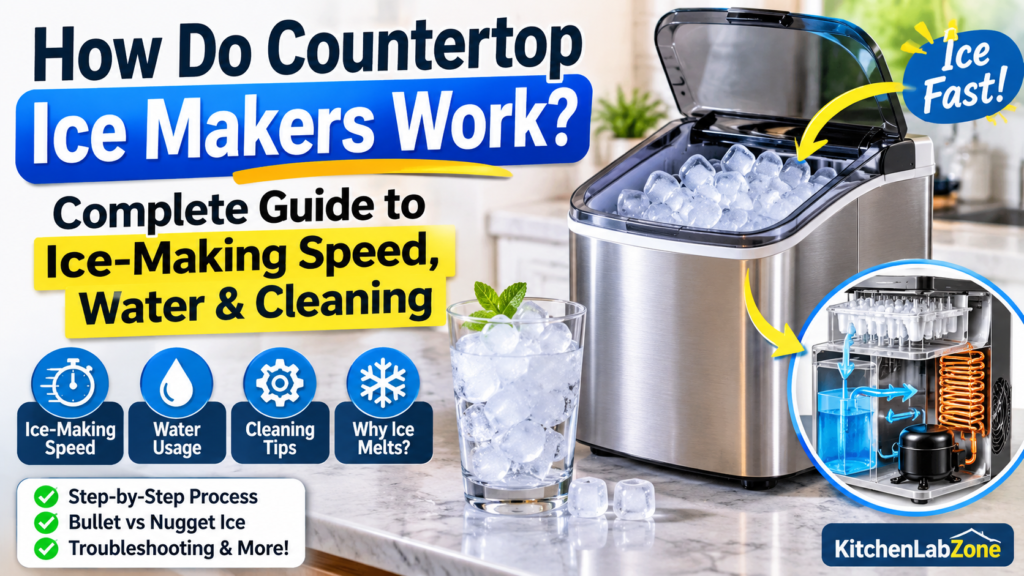
Learn how countertop ice makers work, how fast they make ice, how they use water, why ice melts, and how to clean and maintain your machine.
KitchenLabZone is a reader-supported website. This means that when you click on certain links on our site and make a purchase, we may earn a small commission—at no additional cost to you.
As an Amazon Associate, KitchenLabZone earns from qualifying purchases. These affiliate links help us keep our content free, up-to-date, and helpful for our readers.We only recommend products that we genuinely believe offer value and are relevant to our audience. Our reviews and recommendations are based on research, user feedback, and personal opinions, not influenced by affiliate partnerships.Your support through these links allows us to continue providing high-quality kitchen guides, product reviews, and buying advice.
If you have any questions regarding this disclosure, feel free to contact us.
Thank you for supporting KitchenLabZone!
A countertop ice maker is a small refrigeration machine built to do one job quickly. It pumps water from a reservoir over a metal surface chilled by refrigerant, lets thin layers of ice build up, warms the surface just enough to release the ice, and drops it into a basket. Then it starts over.
That is why it beats a freezer tray. A tray freezes a whole pool of still water using cold air, which typically takes hours. A countertop machine freezes a thin film of moving water against chilled metal, which sheds heat far faster. Consumer Reports notes that these machines can beat a freezer tray, and its fastest tested models finished a cycle every 6 to 8 minutes.
Below, we break down the parts, the full cycle, realistic speed and output, the water system, and cleaning, plus fixes for common problems.
A note on sources: KitchenLabZone did not run its own lab tests for this guide. Speed, capacity, and cleaning figures come from named manufacturers or independent testers, and we say which.
Quick Overview
- How they work: A pump moves water over a refrigerant-chilled metal surface. Thin layers freeze, the surface warms briefly, and the ice drops into a basket.
- First-batch timing: Manufacturers commonly claim about 5 to 15 minutes. Independent testers have recorded anything from a few minutes to nearly half an hour.
- Main components: Compressor, condenser, evaporator, refrigerant, water pump, reservoir, sensors, ice basket, and a harvest mechanism.
- Water requirements: You fill it by hand, with no plumbing. Reservoirs in Consumer Reports’ tests held 1 to 5 liters, with about 2 liters most common.
- Cleaning frequency: It varies by brand, from weekly for some GE Opal models to much longer intervals elsewhere. Hard water means more frequent descaling. Your manual decides.
- Important limitations: These are ice makers, not freezers. Stored ice sits near 32°F and slowly melts, and “pounds per day” claims are ceilings, not what one tank of water delivers.
How Do Countertop Ice Makers Work?
Think of two systems working together. The first is a sealed refrigeration loop, the same basic idea as your refrigerator. A compressor pressurizes refrigerant, a condenser releases heat into room air, and an evaporator turns very cold as refrigerant expands inside it. The second is a water loop: a small pump carries water from the reservoir to the evaporator and back.
When both run, water flows across the cold surface and freezes in layers. Consumer Reports’ appliance engineer describes most models as pumping water over cold metal nubs, letting the layers build into cubes, then heating the metal just long enough for the ice to release into a bin. Sensors tell the machine when ice is ready, when to harvest, and when the basket is full. Water that doesn’t freeze flows back to the reservoir and goes around again.
That is the whole trick: chill a small amount of moving water against metal, then release the ice. The differences between bullet, nugget, and clear machines come from the shape of that cold surface and how the ice is removed from it. For the refrigeration principles behind this, the AHRI technical support document covers the same cycle at commercial scale; consumer machines are smaller and simpler, but the physics is the same.
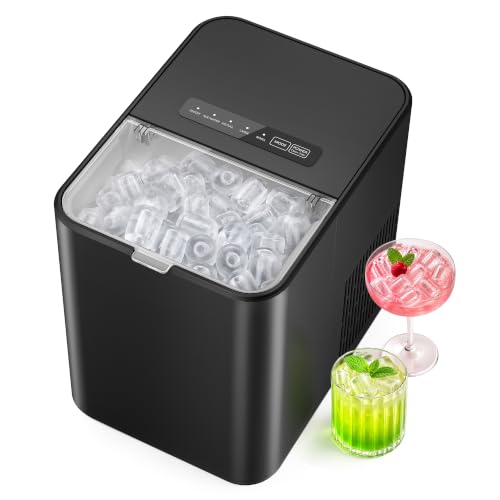
- QUICK ICE FOR DAILY DRINKS: Make 8 smooth bullet-shaped ice cubes in as little as 6 minutes with this countertop ice mak…
- COMPACT, FLEXIBLE PLACEMENT: Measuring 9.84 x 12.36 x 11.14 inches and weighing 13.9 lbs, this portable ice maker fits n…
- TWO BULLET ICE SIZES: Select small or large bullet ice to suit different drinks and occasions. Small cubes can cool soda…
What Happens Inside a Countertop Ice Maker?
| Component | What it does | Why it matters to you |
|---|---|---|
| Compressor | Pressurizes refrigerant so the cooling loop can move heat | Main source of hum and electricity use |
| Condenser | Releases the heat removed from the water into room air | Needs airflow; blocked vents slow ice and add heat |
| Refrigerant | Sealed fluid that carries heat from the evaporator to the condenser | Not user-serviceable |
| Evaporator | The coldest part: prongs, a plate, or a chilled cylinder | This is where water becomes ice |
| Water pump | Moves water from the reservoir to the evaporator | If it runs dry or clogs, ice stops |
| Water reservoir | Holds the water supply | Limits how long you can run before refilling |
| Temperature sensors | Track how cold the evaporator or water is | Tell the machine when to freeze and when to harvest; designs vary |
| Ice-full sensor | Detects when the basket is full | Pauses production to prevent overflow |
| Ice basket | Collects and stores finished ice | Holds only a small amount; not a freezer |
| Harvest mechanism | Warms or scrapes the evaporator so ice releases | Determines ice shape and release speed |
Here is how they cooperate. The pump delivers water, the compressor chills the evaporator, and sensors decide when enough ice has formed. The harvest mechanism then frees the ice, the basket catches it, and the ice-full sensor decides whether to keep going. Commercial machines often release ice by sending hot refrigerant gas through the evaporator; consumer designs differ, and manufacturers rarely publish the details, so we won’t claim one method for every model.
Sensors do collect grime, which is why some manufacturers include them in routine care. GE, for example, recommends cleaning the sensors on its round-button Opal models at least every six months.
Step-by-Step Ice-Making Process
- Filling the water reservoir. You add drinking-quality water up to the fill line. Most machines won’t run, or will flag an alert, when water is low.
- Pumping water toward the freezing mechanism. The pump lifts water from the reservoir to the evaporator’s prongs, plate, or cylinder.
- Refrigeration and heat removal. The compressor runs, refrigerant absorbs heat from the water through the evaporator wall, and the condenser dumps that heat into the room. That’s why the machine feels warm.
- Ice formation. Water freezes in thin layers on the cold surface. On bullet machines, ice builds around metal prongs. On auger-style nugget machines, ice forms on a chilled cylinder wall and is scraped off and compressed into pellets.
- Ice harvesting and release. When sensors indicate the ice is ready, the evaporator warms briefly (or the ice is scraped or pushed off) so it lets go.
- Ice collection. The ice drops or is pushed into the basket. When the ice-full sensor trips, production pauses.
- Water recycling and restarting the cycle. Unfrozen water returns to the reservoir for reuse. Models built to recycle meltwater may also draw melted ice back in. The cycle then restarts until the basket is full or water runs low.
- QUICK ICE FOR DAILY DRINKS: Make 8 smooth bullet-shaped ice cubes in as little as 6 minutes with this countertop ice mak…
- COMPACT, FLEXIBLE PLACEMENT: Measuring 9.84 x 12.36 x 11.14 inches and weighing 13.9 lbs, this portable ice maker fits n…
- TWO BULLET ICE SIZES: Select small or large bullet ice to suit different drinks and occasions. Small cubes can cool soda…
How Long Do Countertop Ice Makers Take to Make Ice?
There’s no single answer, so be wary of any article that gives one.
First batch. Food Network timed the first cycle from pressing “on” to hearing ice drop, and reported a huge spread: a few minutes for some machines, almost half an hour for others. Consumer Reports found its fastest models cycled every 6 to 8 minutes, while others took 10 to 15. Manufacturer claims for both bullet and nugget models commonly fall between about 5 and 15 minutes.
Later batches. Once the evaporator is cold, cycles usually run faster and steadier than the first one. Batches are small, typically around nine or ten bullet cubes, so a full basket takes longer than the headline “first ice” time suggests.
Bullet vs. nugget. Bullet machines often advertise the shortest first-batch times. Nugget machines can make more ice per hour but may need a warm-up period, and results depend heavily on the model.
What changes the speed:
- Room temperature: A hot kitchen makes the condenser work harder and slows ice.
- Water temperature: Starting with cooler water saves the compressor effort. Many people notice slower cycles with warm tap water.
- Ice size settings: Larger ice needs longer to freeze than small ice.
- Ventilation: Machines pressed against walls or cabinets recirculate their own heat. Follow your manual’s clearance rules.
- Maintenance: Mineral scale on the evaporator acts like insulation, so ice forms slowly or thin.
How Much Ice Can a Countertop Ice Maker Produce Per Day?
Five numbers get confused constantly:
- First-batch time: How fast the first ice drops.
- Hourly production: What it makes in steady operation. In Food Network’s one-hour weigh-in, a compact bullet model made about 10 ounces, while a nugget model made 1 pound 14 ounces. Those are single test units, not universal figures.
- Advertised daily production: A theoretical maximum under ideal conditions, often 26 to 44 pounds.
- Actual practical output: What you’ll get given your refills, room, and how often you empty the basket.
- Basket and reservoir capacity: The basket is your ice stockpile. The reservoir is your fuel.
The math explains the gap. A machine advertised at 26 pounds per day averages roughly 1.1 pounds per hour. A 2-liter reservoir holds about 4.4 pounds of water, and a pound of ice starts as about a pound of water. So one tank can’t yield 26 pounds unless melted ice flows back, you keep refilling, and you keep emptying the basket. Consumer Reports’ engineer said the same thing: none of the models tested hold enough water to make their full daily claim without refilling.
Advertised daily production is not the amount stored at once. The basket might hold only a pound or two. Plan on a batch or two per hour, then a pause.
How Does the Water System Work?
Manual filling. There’s no water line. You pour water into the reservoir, so the machine goes wherever there’s an outlet.
Reservoir capacity. Consumer Reports found 1 to 5 liters across tested models, with about 2 liters typical. A bigger tank means fewer refills, not a bigger basket.
Circulation. The pump moves water over the evaporator in a loop. Ice takes the water it needs, and the rest returns to the reservoir.
Meltwater recycling. Designs vary. Some machines pull melted ice back into the reservoir to refreeze; others let meltwater pool at the bottom, where it should be drained. Check your manual rather than assuming.
When to refill. Top off when the low-water indicator appears, and discard old water that has sat for days.
Filtered vs. tap water. Many manufacturers only require potable (drinkable) water. GE says so for its Opal line, and notes that owners who use only distilled water will most likely not need to remove mineral deposits. Other brands have their own rules, so check yours.
Hard water and buildup. Minerals leave scale on the evaporator, sensors, and tubing. GE ties descaling to water hardness for its round-button Opal models, from every 2 to 4 months in soft water (0–4 grains per gallon) to every 2 to 3 weeks above 10 grains. That table applies to those models, but the pattern holds broadly: harder water means more descaling.
How much water does an ice maker use? Roughly one pound (about 0.45 liter) per pound of ice you make, plus whatever you drain during cleaning.
Why Does Ice Melt Inside a Countertop Ice Maker?
Because most portable machines aren’t freezers. Consumer Reports’ engineer notes they store ice around 32°F, versus 0°F in a freezer, so ice should be used soon after it’s made.
- Insulated storage baskets slow melting but don’t stop it.
- Natural melting begins once ice sits at the same temperature at which water freezes.
- Water returning to the reservoir (in compatible models) means melted ice isn’t wasted. It gets frozen again.
- Moving ice to the freezer: If you won’t use it within a while, scoop it into a freezer-safe container. Making ice only when you need it avoids waste.
Ice type matters for dilution too. If most of your ice goes into coffee, see our guide to the best ice makers for iced coffee.
Bullet Ice vs. Nugget Ice: How Do They Work Differently?
Conventional bullet machines freeze water around cold metal prongs, which leaves a hollow center. Nugget machines use an auger-based system: ice forms on a chilled cylinder wall, and a rotating auger scrapes it off and compresses the flakes into soft, chewable pellets. Some products sold as “nugget” or “pellet” ice use molds instead, and Consumer Reports found that most machines it tested freeze water on cold metal surfaces, so confirm the mechanism in the manual.
| Bullet | Nugget | Clear / craft cubes | |
|---|---|---|---|
| Ice formation | Water freezes around cold prongs | Auger scrapes and compresses ice flakes | Slower, directional freezing into larger cubes |
| Texture | Firm, crunchy | Soft, chewable | Dense, hard |
| Shape | Hollow cylinder, closed at one end | Small compressed pellets | Large cubes |
| Production speed | Often the fastest first batch | Can be strong hourly output on some models | Slowest; Consumer Reports’ tested model made three large cubes every 25 to 35 minutes |
| Maintenance | Simpler mechanism; descale and clean | More moving parts; follow cleaning cycle closely | Varies by model |
| Best applications | Everyday water, soda, small spaces | Iced coffee, sodas, chewing, smoothies | Cocktails, slow-melt drinks |
Of the 20 models Consumer Reports tested, 15 made bullet ice, 4 made nugget, and 1 made large cubes. To explore nugget machines, see our best nugget ice makers guide and our GE Profile Opal 2.0 Ultra review. Comparing two popular picks? Read GE Profile Opal 2.0 vs. NewAir nugget ice maker.
How to Clean a Countertop Ice Maker
Always start with your manual. Procedures and chemicals differ by model, and a method that’s safe for one machine can damage another.
- Turn off and unplug the machine. Let it rest if your manual says so; GE asks for an hour on its round-button Opal models.
- Remove remaining ice and discard it.
- Drain the water reservoir using the drain plug or hoses.
- Clean removable components. Wash the basket and scoop by hand with mild soap and warm water. NewAir says not to put plastic parts in the dishwasher.
- Clean the reservoir following the manufacturer’s instructions. Some say never to use soap there, so check first.
- Run the approved cleaning cycle using only the cleaner your manual names.
- Descale mineral deposits when necessary, using the approved descaler or method.
- Rinse thoroughly. Run fresh-water rinse cycles until no cleaner smell or taste remains.
- Drain and dry the machine, especially before storing it.
Cleaning, sanitizing, and descaling are different jobs. Routine cleaning removes slime and residue from parts that touch water and ice. Sanitizing aims to reduce microbes, using a method the manufacturer approves. Descaling dissolves mineral scale. A self-clean cycle doesn’t always do all three.
How often? Intervals vary a lot. GE recommends weekly cleaning for round-button Opal models, and monthly if you use only distilled water. Food Network suggests every one to two weeks as a rule of thumb and before and after long periods of non-use. NewAir’s cleaning guide cites a far longer interval, about once every nine months, with more frequent cleaning for hard water or high humidity. In practice, clean sooner if you run it daily, use hard water, or notice odd tastes. GE’s Opal cleaning and descaling page shows what a manufacturer-specific procedure looks like; apply it only to the models it covers.
Safety warning: Never mix bleach with vinegar or any other cleaning chemical. Use only products your appliance manual approves, and don’t copy another brand’s chemical recipe.
Common Countertop Ice Maker Problems and Solutions
| Problem | Likely causes | What to try |
|---|---|---|
| Slow ice | Warm room or water, poor ventilation, scale | Add clearance, use cooler water, descale |
| Small or thin ice | Scale on the evaporator, low water, small-ice setting | Descale, refill, check size setting |
| Not making ice | Full basket, blocked ice-full sensor, low water, clean mode, power | Empty basket, wipe sensors, refill, confirm “ice” mode |
| Water not circulating | Low water, clogged filter or screen, scale in tubing | Refill, clean the intake, descale. GE notes water won’t circulate during cleaning unless the filter is swapped for the screen. |
| Unusual noise | Compressor hum (normal), pump running dry, ice jam, loose basket | Refill, clear jams, reseat parts |
| Stops unexpectedly | Full basket, low water, overheating, dirty sensor | Check water, ventilation, sensors |
| Bad-tasting ice | Stale water, residue, new-unit smell | Drain, clean, refill with fresh water, discard first batches if the manual suggests |
| Mineral buildup | Hard water | Descale per manual; consider filtered or distilled water if permitted |
| Poor ventilation | Tight cabinet, wall contact | Follow the clearance in the manual |
If the machine still misbehaves after cleaning and descaling, contact the manufacturer rather than opening a sealed refrigeration system.
How Much Electricity Does a Countertop Ice Maker Use?
Most portable machines use a compressor that cycles on and off, so draw isn’t constant. The compressor is the biggest electrical load, and it works harder in a hot room or when airflow is blocked.
You can estimate your own cost without guessing. Find the rated watts on the label or manual, divide by 1,000, multiply by hours the compressor actually runs, then multiply by your local rate per kilowatt-hour. For example, a hypothetical 100-watt machine running 8 hours uses 0.8 kWh, and your utility bill converts that into dollars. Because rated power isn’t continuous draw, treat the result as an upper-end estimate.
To keep usage down: give the machine ventilation, keep it out of direct sun, clean it regularly, and make ice when you need it instead of running it all day.
Are Countertop Ice Makers Worth It?
Advantages: Ice in minutes, no freezer space, no plumbing, fresh ice on demand, and nugget ice that’s hard to make at home otherwise.
Disadvantages: Counter space, noise, regular cleaning, small baskets, and ice that melts. They’re not a long-term ice storage solution.
Maintenance: Plan on weekly or biweekly cleaning for daily use, plus descaling in hard-water areas.
Best for: People who use a lot of ice, entertain, drink iced coffee daily, or have no fridge ice maker. If you rarely use ice, trays are cheaper. If budget is the main concern, bullet machines start far lower than nugget models.
Ready to compare models? Our best countertop ice makers guide lays out options by ice type, size, and cleaning effort.
Frequently Asked Questions
1. How does a portable countertop ice maker work?
It pumps water from a small reservoir over a refrigerated metal surface, where thin layers freeze into ice. The surface then warms briefly so the ice drops into a basket, and the cycle repeats until the basket is full or the water runs low.
2. Does a countertop ice maker need a water line?
No. Portable models are filled by hand. Most hold roughly one to five liters, with about two being common, so you refill when the low-water indicator comes on.
3. How long does it take to make the first batch of ice?
Manufacturers commonly claim about 5 to 15 minutes. Consumer Reports found its fastest models cycled every 6 to 8 minutes, and Food Network saw first-cycle times range from a few minutes to nearly half an hour. Room temperature, water temperature, and ice-size settings all matter.
4. Can you leave water in a countertop ice maker?
Not for long. Standing water can pick up odors, and a damp machine can allow mold and bacteria to grow. If you won’t use it for several days, drain the reservoir and dry the machine as your manual directs.
5. Does a countertop ice maker keep ice frozen?
No. These machines store ice at about 32°F, compared with 0°F in a freezer, according to Consumer Reports, so ice slowly melts. Move extra ice to a freezer container.
6. Can you use tap water in an ice maker?
Usually, yes. Many manufacturers say drinking-quality water is enough, though hard tap water leaves mineral scale that calls for more frequent descaling. Filtered or distilled water can reduce buildup, but check your manual.
7. How often should you clean a countertop ice maker?
It depends on the manufacturer. GE recommends weekly cleaning for certain Opal models, Food Network suggests every one to two weeks as a rule of thumb, and some brands list much longer intervals. Clean sooner if ice tastes off or you have hard water.
8. Why is my countertop ice maker making small ice cubes?
Common causes are warm room or water, mineral buildup, low water, a dirty sensor, or a small-ice setting. Descale and clean according to your manual, give the unit ventilation, and check the size setting.
9. Do countertop ice makers recycle melted ice?
Some do and some don’t, depending on design. In compatible models, meltwater flows back to the reservoir to be refrozen. In others it collects at the bottom and should be drained, so check your manual.
10. How long can a countertop ice maker run continuously?
Most machines pause automatically when the basket is full, and they can keep making ice as long as there’s water and airflow. There’s no universal run-time limit, so check your manual and avoid running one with an empty reservoir.
Conclusion
A countertop ice maker is a compact refrigeration loop plus a water loop. The pump moves water over a cold evaporator, the ice forms in thin layers, the machine releases it into a basket, and unfrozen water goes back for another round. Bullet machines freeze around prongs. Nugget machines compress scraped ice flakes. Clear-ice models freeze slowly into larger cubes.
Before you buy, remember three things. First, ignore the daily-output headline and look at basket size, hourly output, and reservoir capacity. Second, remember these are ice makers, not freezers, so use the ice soon. Third, budget time for cleaning and descaling, especially with hard water. When you’re ready to shop, start with our detailed countertop ice maker buying guide.
KitchenLabZone is reader-supported. When you buy through links on our site, we may earn a commission at no extra cost to you.
Publishing Package
- SEO title (58 characters): How Do Countertop Ice Makers Work? Speed, Water & Cleaning
- Meta description (153 characters): Learn how countertop ice makers work, how fast they make ice, how the water system recycles meltwater, and how to clean and descale yours safely at home.
- URL slug: how-countertop-ice-makers-work
- Primary focus keyword: How Do Countertop Ice Makers Work
- Secondary keywords: how does a countertop ice maker work; how portable ice makers work; how fast do countertop ice makers make ice; countertop ice maker cleaning; how much water does an ice maker use; how do nugget ice makers work; how does a bullet ice maker work; countertop ice maker water recycling; why does ice melt in countertop ice makers; how often to clean a portable ice maker
- Featured image concept: A clean cutaway-style illustration of a countertop ice maker on a bright kitchen counter, with simple labels pointing to the water reservoir, cold evaporator prongs, and ice basket, and a glass of ice water beside it. No brand logos.
- Image alt text: Cutaway illustration of a countertop ice maker showing reservoir, evaporator prongs, and ice basket
Internal links used
- Best ice makers for iced coffee
- Best nugget ice makers
- GE Profile Opal 2.0 Ultra review
- GE Profile Opal 2.0 vs. NewAir
- Best countertop ice makers (used twice, as requested)