

Best stand mixers under $300 in 2026 for home bakers. Compare affordable, powerful mixers for bread dough, cakes, cookies, and everyday baking.
KitchenLabZone is a reader-supported website. This means that when you click on certain links on our site and make a purchase, we may earn a small commission—at no additional cost to you.
As an Amazon Associate, KitchenLabZone earns from qualifying purchases. These affiliate links help us keep our content free, up-to-date, and helpful for our readers.We only recommend products that we genuinely believe offer value and are relevant to our audience. Our reviews and recommendations are based on research, user feedback, and personal opinions, not influenced by affiliate partnerships.Your support through these links allows us to continue providing high-quality kitchen guides, product reviews, and buying advice.
If you have any questions regarding this disclosure, feel free to contact us.
Thank you for supporting KitchenLabZone!
If you’ve spent any time shopping for a stand mixer, you already know the frustration: the “best” mixers everyone recommends often cost $400 or more, and it’s not always clear whether a cheaper model will actually hold up to weekly baking. Picking the wrong mixer under $300 can mean a motor that bogs down in stiff cookie dough, a bowl that’s too small for your favorite bread recipe, or a machine that rattles across the counter every time you turn it on.
The good news is that best stand mixers under $300 isn’t a contradiction. Spending more doesn’t automatically mean better results for most home bakers — it often just means more attachments, more color options, and a bigger price tag for features you may never use. This guide breaks down real, currently available stand mixers that fit a $300 budget, based on published specifications, manufacturer data, and available testing from independent reviewers. It’s built for beginner bakers, weekend bread makers, cookie enthusiasts, and anyone who wants a mixer that performs well without the premium price.

- 500W motor.59-point planetary mixing action
- 5.5 quart capacity, polished stainless steel bowl
- 12 speeds for precise mixing

- 5qt Stainless-Steel Bowl – Compatible with all 4.5 and 5 Quart KitchenAid Tilt Head Stand Mixers – Compatible with Artis…
- 5qt Stainless-Steel Bowl – With this beautiful polished stainless-steel bowl you can make a big size dough without any i…
- High Quality Stainless-Steel – The bowl is made of High Quality premium 304 stainless steel, foodgrade and nontoxic, not…

- BUILT TO LAST: Enjoy years of top mixing performance and timeless style in your kitchen. This 12 speed stand mixer has d…
- 400 WATT MOTOR EFFORTLESSLY POWERS THROUGH INGREDIENTS: This Hamilton Beach stand mixer has a powerful 400 watt motor th…
- MIXING VERSATILITY WITH 3 ATTACHMENTS, POUR SHIELD AND 4.5 QT. BOWL: The stand mixer includes a dough hook for kneading,…

- THOROUGH MIXING AND COMPLETE BOWL COVERAGE. As you mix, each stand mixer attachment rotates around the entire bowl as it…
- POWERS THROUGH THE THICKEST DOUGH AND MAINTAINS CONSTANT SPEED. No matter how thick or heavy your ingredients are, the p…
- PROVIDES MIXING VERSATILITY — DOUGH HOOK, WHISK AND FLAT BEATER INCLUDED: Three versatile attachments let you do everyth…
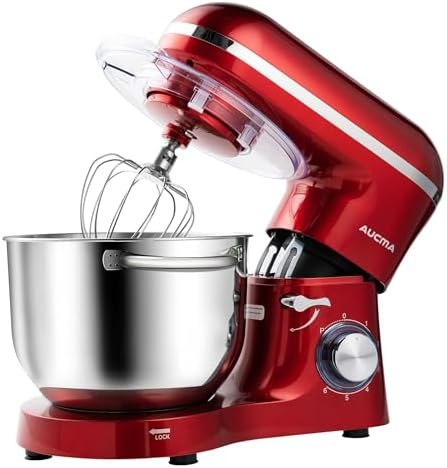
- Powerful Motor and Variable Speed Control – 660W high performance pure copper motor and sturdy ABS housing; 6 optimized …
- 6.5QT Large Capacity Bowl With Handles – 6.5QT Stainless steel bowl can meet all your kitchen needs. The Stand Mixer is …
- Tilt Head and Outside Design – The tilt-head design mixer allows access to install or uninstall bowl and accessories eas…
Quick Overview
| Stand Mixer | Best For | Bowl Size | Key Strength | Price Range |
|---|---|---|---|---|
| Cuisinart Precision Master SM-50 | Overall value & everyday baking | 5.5 qt | 500W motor, 12 speeds, die-cast metal body | ~$199–$299 |
| KitchenAid Classic Series K45SS | KitchenAid attachment ecosystem | 4.5 qt | Compatible with 10+ KitchenAid attachments | ~$259–$349* |
| Hamilton Beach Eclectrics All-Metal | Budget-conscious beginners | 4.5 qt | All-metal build at a fraction of the price | ~$99–$180 |
| Hamilton Beach 4-Quart 7-Speed | Small kitchens & occasional bakers | 4 qt | Compact footprint, easy storage | ~$99–$150 |
| Aucma 6.5-Quart 660W | Large-batch and big-family baking | 6.5 qt | Largest bowl capacity on this list | ~$99–$150 |
The KitchenAid Classic’s price regularly hovers at or slightly above $300 depending on color and retailer — see the full review below.
Product Comparison Table
| Model | Price | Bowl Capacity | Power | Speeds | Mixer Type | Best For |
|---|---|---|---|---|---|---|
| Cuisinart Precision Master SM-50 | ~$199–$299 | 5.5 qt | 500W | 12 | Tilt-back head | Home bakers who want the most power for the money |
| KitchenAid Classic K45SS | ~$259–$349 | 4.5 qt | 275W | 10 | Tilt-head | Buyers who want the KitchenAid name and attachment hub |
| Hamilton Beach Eclectrics All-Metal | ~$99–$180 | 4.5 qt | 400W | 12 | Tilt-head | Beginners who want solid build quality on a tight budget |
| Hamilton Beach 4-Quart 7-Speed | ~$99–$150 | 4 qt | 300W | 7 | Tilt-head | Small kitchens, occasional bakers |
| Aucma 6.5-Quart 660W | ~$99–$150 | 6.5 qt | 660W | 6 | Tilt-head | Large batches on a small budget |
Check current prices on Amazon:
- Check Price on Amazon: Cuisinart Precision Master SM-50
- Check Price on Amazon: KitchenAid Classic K45SS
- Check Price on Amazon: Hamilton Beach Eclectrics All-Metal
- Check Price on Amazon: Hamilton Beach 4-Quart 7-Speed
- Check Price on Amazon: Aucma 6.5-Quart 660W
Prices change frequently on Amazon and other retailers. Always confirm the current price before purchasing — see our price disclaimer below.
Who Should Buy a Stand Mixer Under $300?
A budget-friendly stand mixer is a smart choice for:
- Beginner bakers who want to move up from a hand mixer without a big financial commitment
- Regular home bakers making cookies, cakes, muffins, and quick breads a few times a week
- Cookie and cake bakers who need consistent creaming and whipping, not heavy-duty commercial output
- Occasional bread and pizza dough makers who knead dough less than a few times a week
- Small families and individuals who don’t need to mix 8+ dozen cookies in one batch
- Budget-conscious shoppers who want a reliable machine without paying for a brand name alone
You may want to spend more than $300 if you bake bread multiple times a week, regularly work with very stiff or high-hydration doughs, run a small baking business, or need a bowl larger than 6.5 quarts for consistently large batches. In those cases, a bowl-lift mixer with a more powerful, geared motor is usually a better long-term investment.
Are Stand Mixers Under $300 Actually Good?
Yes — with realistic expectations. Mixers in this price range handle the everyday baking tasks most home cooks actually do: creaming butter and sugar, mixing cake batter, whipping cream and egg whites, and making frosting. Several models here, including the Cuisinart SM-50, have been reviewed favorably by independent publications for exactly these tasks.
Where budget mixers show their limits is with dense bread dough and large-batch pizza dough. A tilt-head mixer under $300 can generally handle a single loaf of sandwich bread or a modest batch of pizza dough, but stiffer, low-hydration doughs (like bagel dough) or doubled bread recipes can strain smaller, lower-wattage motors and cause the machine to walk across the counter. Manufacturer guidance for most of these models recommends against exceeding the rated dough capacity for exactly this reason.
Bottom line: for everyday baking, cookies, cakes, whipped cream, and frosting, mixers under $300 perform well. For frequent, heavy bread baking, expect more compromises — or plan to work in smaller batches.
What You Usually Give Up Below $300
Choosing a mixer under $300 does involve some trade-offs compared to premium bowl-lift machines:
- Smaller bowl capacity — most models here top out at 4.5 to 6.5 quarts, versus 7+ quarts on premium bowl-lift mixers
- Lighter overall construction — several budget mixers use plastic housings around a metal motor, rather than all-metal bodies
- More vibration and movement — lighter mixers can shift on the counter during heavy mixing, especially with stiff dough
- Reduced heavy-dough performance — lower-wattage, direct-drive motors can bog down with very stiff or oversized dough batches
- Smaller attachment ecosystems — only KitchenAid’s hub-powered attachment system offers the wide range of add-ons (pasta rollers, grinders, spiralizers) available at this price point
- Simpler speed controls — some budget models use fewer, less finely graduated speed settings
- Shorter or less-publicized warranties on some off-brand models compared to established brands
None of these are dealbreakers for everyday baking — they’re simply the realistic trade-offs of staying under budget.
Product Reviews
Cuisinart Precision Master SM-50
- 500W motor.59-point planetary mixing action
- 5.5 quart capacity, polished stainless steel bowl
- 12 speeds for precise mixing
Why It Stands Out
The Cuisinart Precision Master SM-50 consistently comes up as one of the strongest all-around picks under $300. It pairs a 5.5-quart bowl — larger than the KitchenAid Classic’s 4.5-quart bowl — with a 500-watt motor and die-cast metal construction, all while typically pricing below the KitchenAid Classic depending on color. Tom’s Guide named it an Editor’s Choice, calling it a strong option for bakers who can’t stretch their budget to a KitchenAid.
Key Features
- 5.5-quart polished stainless steel bowl
- 500-watt motor, 12 speeds
- Die-cast metal body construction
- Tilt-back head design
- Includes chef’s whisk, dough hook, flat mixing paddle, and splash guard with pour spout
- Dishwasher-safe bowl and attachments
- Manufacturer’s limited 3-year warranty
Performance
According to published testing from Tom’s Guide, the mixer performed well across the outlet’s baking tests, with the 5.5-quart bowl offering ample room for everyday recipes. The review positions the SM-50 as a worthwhile pick for bakers who don’t want to pay KitchenAid pricing. Manufacturer specifications indicate the 500-watt motor and planetary mixing action are designed to handle everything from soft batters to sticky bread doughs, though independent testers have noted that ingredients can occasionally get pushed to the edge of the bowl during heavy mixing, per user-reported feedback compiled by retail review aggregators.
Pros
- Larger bowl than the KitchenAid Classic, at a comparable or lower price
- More powerful motor (500W vs. 275W on the KitchenAid Classic)
- 12 speed settings for finer control
- Die-cast metal body feels sturdier than many budget alternatives
- Wide range of color options
Cons
- The splash guard can be fiddly to fit and remove
- Some users report ingredients collecting on the bowl’s edge during mixing
- No hub-powered attachment ecosystem like KitchenAid’s
Best For
Home bakers who want the most bowl capacity and motor power for the price, without paying extra for a brand name.
Who Should Skip It
Bakers who specifically want access to KitchenAid’s wide range of hub-powered attachments (pasta rollers, meat grinders, spiralizers) should consider the KitchenAid Classic instead.
Price & Value
Pricing varies by color, generally landing between roughly $199 and $299. At the lower end of that range, it’s one of the strongest value picks in this guide; even at the higher end, it remains competitively priced against the KitchenAid Classic while offering more capacity and power.
KitchenAid Classic Series K45SS
- 5qt Stainless-Steel Bowl – Compatible with all 4.5 and 5 Quart KitchenAid Tilt Head Stand Mixers – Compatible with Artis…
- 5qt Stainless-Steel Bowl – With this beautiful polished stainless-steel bowl you can make a big size dough without any i…
- High Quality Stainless-Steel – The bowl is made of High Quality premium 304 stainless steel, foodgrade and nontoxic, not…
Why It Stands Out
The KitchenAid name carries real weight for a reason: the Classic Series is the entry point into KitchenAid’s tilt-head lineup and is compatible with the brand’s extensive catalog of hub-powered attachments. According to KitchenAid’s product page, the Classic Plus Series 4.5 Quart Tilt-Head Stand Mixer is built to last and features 10 speeds to gently knead, thoroughly mix, and whip ingredients for a wide variety of recipes.
Key Features
- 4.5-quart stainless steel bowl
- 275-watt motor, 10 speeds
- Tilt-head design for easy ingredient access
- Includes coated flat beater, coated dough hook, and 6-wire whip
- Compatible with 10+ optional hub-powered attachments (sold separately)
- Durable metal construction
Performance
Manufacturer specifications describe durable, built-to-last metal construction with 59 touchpoints around the mixer bowl for mixing results, and the mixer is rated to handle up to 8 dozen cookies in a single batch using the flat beater. The Classic’s 275-watt motor is on the lighter side compared to the Cuisinart SM-50 (500W), so it’s best suited to cookies, cakes, and light-to-moderate bread doughs rather than dense, high-volume bread batches.
Pros
- Access to KitchenAid’s large attachment ecosystem
- Strong resale value and brand recognition
- Compact tilt-head design suits smaller kitchens
- Simple, reliable 10-speed control
Cons
- Smallest bowl and lowest wattage among the mixers on this list
- Price frequently sits at or above the $300 mark depending on color and retailer
- Fewer speeds than the Cuisinart SM-50 or Hamilton Beach Eclectrics
Best For
Buyers who specifically want the KitchenAid attachment ecosystem and brand reliability, and who mostly bake cookies, cakes, and lighter doughs.
Who Should Skip It
Bakers who bake bread regularly, or who want the largest bowl and most power for the money, will likely get more value from the Cuisinart SM-50.
Price & Value
A price note: the KitchenAid Classic’s price fluctuates more than any other mixer on this list. It has been observed on sale as low as the high $200s and, depending on color and retailer, has also listed above $300. Because of that fluctuation, treat this pick as a “right at the budget line” option — check the current price carefully before buying, since it may occasionally exceed the $300 cap this guide is built around.
Hamilton Beach Eclectrics All-Metal Stand Mixer
- BUILT TO LAST: Enjoy years of top mixing performance and timeless style in your kitchen. This 12 speed stand mixer has d…
- 400 WATT MOTOR EFFORTLESSLY POWERS THROUGH INGREDIENTS: This Hamilton Beach stand mixer has a powerful 400 watt motor th…
- MIXING VERSATILITY WITH 3 ATTACHMENTS, POUR SHIELD AND 4.5 QT. BOWL: The stand mixer includes a dough hook for kneading,…
Why It Stands Out
The Eclectrics All-Metal stand mixer punches well above its price point on paper: a 400-watt motor and 12 speeds, both higher than the KitchenAid Classic, in an all-metal body that typically costs a fraction of the price of the brand-name competition.
Key Features
- 4.5-quart stainless steel locking bowl with handle
- 400-watt motor, 12 speeds
- Professional two-way rotating (planetary) mixing action
- Quick-release, tilt-up head
- Includes dough hook, flat beater, whisk, and pouring shield
- Dishwasher-safe bowl and attachments
- 3-year limited warranty
Performance
According to the product’s listed specifications, the mixer uses the same professional 2-way rotating mixing action style found on higher-priced mixers, powered by a powerful 400-watt motor. Retailer-compiled customer feedback frequently highlights that it has 400 watts of power for heavy mixing tasks and covers everything in the bowl smoothly, with a sturdy build that provides stability. As with any mixer in this weight class, very stiff bread doughs will tax the motor more than lighter cake and cookie batters.
Pros
- All-metal construction at a strongly discounted price point versus KitchenAid
- Higher wattage than the KitchenAid Classic
- 12 speed settings
- Frequently available well under $200, sometimes closer to $100 during sales
Cons
- Hand-wash recommended for the mixer body (bowl and attachments are dishwasher-safe)
- Smaller attachment ecosystem than KitchenAid
- Fewer independent lab tests available compared to Cuisinart or KitchenAid
Best For
Budget-conscious beginners and everyday bakers who want solid, all-metal build quality without paying premium-brand pricing.
Who Should Skip It
Bakers who want a large third-party attachment catalog (pasta makers, grinders) should look at the KitchenAid Classic instead.
Price & Value
This is one of the strongest value picks in this guide. Prices typically range from under $100 during sales up to around $180 at regular pricing — well under the $300 cap, with metal construction and specs that compete with pricier machines.
Hamilton Beach 4-Quart 7-Speed Stand Mixer
- THOROUGH MIXING AND COMPLETE BOWL COVERAGE. As you mix, each stand mixer attachment rotates around the entire bowl as it…
- POWERS THROUGH THE THICKEST DOUGH AND MAINTAINS CONSTANT SPEED. No matter how thick or heavy your ingredients are, the p…
- PROVIDES MIXING VERSATILITY — DOUGH HOOK, WHISK AND FLAT BEATER INCLUDED: Three versatile attachments let you do everyth…
Why It Stands Out
For bakers with limited counter or storage space, or who bake only occasionally, this compact 4-quart model offers a lighter-duty option at one of the lowest price points in this guide.
Key Features
- 4-quart stainless steel bowl
- 300-watt motor, 7 speeds
- Planetary mixing action for full bowl coverage
- Includes dough hook, flat beater, and wire whisk
- Tilt-head design
- Compact footprint for smaller kitchens
Performance
Per the manufacturer’s listed specifications, the 300-watt motor is designed to easily mix thick batters and doughs for bread, cookies, and more, and the planetary mixing action rotates the beaters around the sides of the bowl for thorough, hands-free mixing, using the same rotating mixing action as KitchenAid stand mixers. This model is best suited to everyday tasks like cookie dough, cake batter, and light bread doughs rather than large or dense batches, given its smaller 4-quart bowl and more modest motor.
Pros
- One of the most affordable stand mixers in this guide
- Compact size is easy to store
- Dishwasher-safe bowl and attachments
- Simple, beginner-friendly controls
Cons
- Smallest bowl capacity on this list
- Lower wattage limits performance with heavier doughs
- Fewer speed settings than the Eclectrics or Cuisinart models
Best For
Occasional bakers, small households, and anyone with limited kitchen counter space who mostly makes cookies, cakes, and light doughs.
Who Should Skip It
Anyone who regularly makes bread, doubles recipes, or wants a larger-capacity bowl should look at the Aucma 6.5-quart or Cuisinart SM-50 instead.
Price & Value
Typically priced well under $150, this is a strong entry-level pick for anyone who wants stand-mixer convenience without committing to a larger investment.
Aucma 6.5-Quart 660W Stand Mixer
- Powerful Motor and Variable Speed Control – 660W high performance pure copper motor and sturdy ABS housing; 6 optimized …
- 6.5QT Large Capacity Bowl With Handles – 6.5QT Stainless steel bowl can meet all your kitchen needs. The Stand Mixer is …
- Tilt Head and Outside Design – The tilt-head design mixer allows access to install or uninstall bowl and accessories eas…
Why It Stands Out
The Aucma stand mixer offers the largest bowl capacity in this guide — 6.5 quarts — along with the highest wattage motor (660W), all at one of the lowest price points among the mixers reviewed here. It’s an appealing option for bakers who need to mix large batches on a tight budget.
Key Features
- 6.5-quart stainless steel bowl
- 660-watt motor, 6 speeds plus pulse function
- ABS plastic housing with stainless steel bowl
- Tilt-head design
- Includes dough hook, wire whip, and beater
- Dishwasher-safe bowl (attachments vary by listing)
Performance
Manufacturer specifications describe the mixer as using a 660W high-performance pure copper motor with 6 optimized speeds and a pulse function for a variety of recipes. Independent, aggregated user feedback is mixed: praised points include ease of use and effective performance for tasks like cookie dough, while reported drawbacks include a lightweight, largely plastic construction that can cause the mixer to wobble during use and struggle with thicker ingredients, sometimes leaving them unmixed on the sides. In short, the large bowl and high wattage look strong on paper, but real-world stability during heavy mixing is a known trade-off.
Pros
- Largest bowl capacity in this guide (6.5 quarts)
- Highest-rated motor wattage on this list
- Very affordable relative to capacity
- Suction-cup base for added stability
Cons
- Primarily plastic housing, aside from the bowl
- Reported wobbling during heavy mixing tasks
- Fewer speed settings than Cuisinart or Hamilton Beach Eclectrics
- Less established brand reputation than KitchenAid, Cuisinart, or Hamilton Beach
Best For
Bakers who need maximum bowl capacity for large families or batch baking and are comfortable with a lighter-duty build in exchange for size and price.
Who Should Skip It
Bakers who prioritize sturdy, all-metal construction over sheer bowl size should choose the Hamilton Beach Eclectrics or Cuisinart SM-50 instead.
Price & Value
Typically priced under $150, the Aucma offers the most capacity per dollar in this guide — a reasonable trade-off for bakers who prioritize batch size over build quality.
Best Stand Mixer Under $300 for Different Types of Bakers
Best for beginners: The Hamilton Beach Eclectrics All-Metal offers sturdy construction, a reasonable 400-watt motor, and simple controls at an approachable price — a good way to learn what you actually want from a stand mixer before investing more.
Best for bread dough: The Cuisinart SM-50’s 500-watt motor and larger 5.5-quart bowl give it more headroom for kneading bread dough than the smaller, lower-wattage options on this list, though it’s still best suited to single-loaf and moderate pizza dough batches rather than dense, high-volume bread baking.
Best for cookies and cakes: The KitchenAid Classic is well-suited here — its 4.5-quart bowl and 10-speed control are built around exactly these everyday tasks, and its rating for up to 8 dozen cookies per batch (using the flat beater) covers most home baking needs.
Best for large batches: The Aucma 6.5-Quart is the clear capacity leader in this group, useful for bakers who regularly cook for a crowd or double recipes.
Best compact option: The Hamilton Beach 4-Quart 7-Speed has the smallest footprint here, ideal for kitchens with limited counter or cabinet space.
Best KitchenAid alternative: The Cuisinart SM-50 offers more bowl capacity and motor power than the KitchenAid Classic, generally at a comparable or lower price — making it the strongest non-KitchenAid pick for most buyers.
Best value: The Hamilton Beach Eclectrics All-Metal, thanks to its all-metal build and 400-watt motor at a price that’s often well under $200.
Best for occasional bakers: The Hamilton Beach 4-Quart 7-Speed is an easy, low-commitment entry point for anyone who bakes a few times a month rather than weekly.
Buying Guide: What to Look for in a Stand Mixer Under $300
Bowl Capacity
- 3.5–4 quarts: Suitable for individuals, couples, or small households baking in small batches — cookies, a single cake, or light doughs.
- 5 quarts: A solid middle ground for most home bakers, handling everyday recipes and modestly sized batches of bread or cookie dough.
- 5.5–6.5 quarts+: Best for larger families, frequent entertaining, or anyone who regularly doubles recipes or bakes bread in larger volumes.
Motor and Power
Wattage is a useful data point, but it shouldn’t be the only factor in your decision. A higher-wattage motor generally has more headroom for stiff doughs, but gearing, construction quality, and manufacturer guidance for maximum dough capacity all affect real-world performance more than the wattage number alone. Always check the manufacturer’s stated maximum flour or dough capacity rather than relying on watts as a stand-in for mixing power.
Tilt-Head vs. Bowl-Lift
All five mixers in this guide use a tilt-head design, where the motor head tilts back to expose the bowl. Tilt-head mixers are generally more compact and easier to store, but bowl-lift mixers (more common above $300) tend to offer more stability and higher dough capacity, since the bowl — not the head — moves, keeping the motor’s weight centered.
Number of Speeds
More speed settings allow finer control between very slow (for adding flour without a mess) and very fast (for whipping cream or egg whites). However, more speeds don’t automatically mean better mixing — motor quality, gearing, and bowl design matter just as much as the number on the dial.
Attachments
At minimum, look for a mixer that includes:
- Flat beater — for cookie dough, cake batter, and general mixing
- Dough hook — for kneading bread and pizza dough
- Wire whisk — for whipping cream, egg whites, and meringue
Some models add a flex-edge beater that scrapes the bowl as it mixes, reducing the need to stop and scrape manually. Optional attachments (pasta rollers, meat grinders, spiralizers) are most widely available for KitchenAid’s hub-powered ecosystem.
Stability and Weight
Heavier mixers with metal bodies tend to stay more planted on the counter during heavy mixing, which matters most with stiff bread or cookie dough. Lighter, plastic-bodied mixers can shift or “walk” during demanding tasks — a trade-off worth weighing against their lower price and often larger bowl capacity.
Noise
If you plan to use your mixer frequently — especially early in the morning or with kids napping nearby — noise level is worth considering. Reviewers commonly note noise differences between models even at similar wattages, largely due to motor type and housing material.
Cleaning
Most mixers in this price range include dishwasher-safe bowls and attachments, which is worth confirming for the specific model and color you’re considering, since it can vary. The mixer body itself typically should be wiped down by hand rather than submerged or run through a dishwasher.
Stand Mixer Under $300 vs. More Expensive Mixers
What you can get for $100–$150: Compact, lower-wattage mixers like the Hamilton Beach 4-Quart 7-Speed or the Aucma 6.5-Quart. These handle everyday cookies, cakes, and light doughs well, with some trade-offs in build quality or stability under heavier loads.
What you can get for $150–$200: Sturdier, all-metal options like the Hamilton Beach Eclectrics, plus entry-level Cuisinart SM-50 colorways. You start to see higher wattage and more durable construction at this tier.
What you can get for $200–$300: The Cuisinart SM-50 at its higher price points, and the KitchenAid Classic. This range typically buys the most bowl capacity, motor power, and brand reputation available before crossing into premium territory.
When spending above $300 may make sense: If you bake bread multiple times a week, want a bowl-lift design for maximum stability, need a bowl larger than 6.5 quarts, or want access to a full attachment ecosystem with heavier-duty hub power, a model like the KitchenAid Artisan (typically $380–$450) may be worth the extra investment. For occasional bakers and most everyday home baking, the mixers in this guide cover the vast majority of real-world use cases.
Stand Mixer vs. Hand Mixer
| Feature | Stand Mixer | Hand Mixer |
|---|---|---|
| Hands-free mixing | Yes | No — requires holding throughout |
| Heavy dough | Better suited, especially with a dough hook | Struggles with stiff or heavy dough |
| Storage | Requires more counter or cabinet space | Compact, easy to store in a drawer |
| Price | Generally $100–$300+ | Generally $20–$80 |
| Large batches | Handles bigger batches more easily | Limited by bowl size and arm fatigue |
| Best for | Frequent bakers, bread and dough recipes, hands-free multitasking | Occasional bakers, small batches, quick mixing tasks |
If you bake only occasionally or have very limited storage space, a hand mixer may be all you need. If you bake regularly, work with dough, or want to multitask while mixing, a stand mixer under $300 is the better long-term investment.
Frequently Asked Questions
What is the best stand mixer under $300? There isn’t a single universal “best,” since it depends on your priorities. The Cuisinart Precision Master SM-50 offers the strongest combination of bowl capacity, motor power, and price for most home bakers. The KitchenAid Classic is the better choice if you specifically want access to KitchenAid’s attachment ecosystem.
Is a stand mixer under $300 worth it? For most home bakers — cookies, cakes, muffins, quick breads, whipped cream, and occasional bread or pizza dough — yes. The mixers in this guide handle these tasks well based on published specifications and available testing. Frequent, heavy bread bakers may eventually want to upgrade to a bowl-lift model above $300.
What is the best budget stand mixer for bread dough? Among the options here, the Cuisinart SM-50 has the highest motor wattage (500W) paired with a larger 5.5-quart bowl, giving it the most headroom for bread dough. Even so, expect it to handle single loaves and moderate pizza dough batches better than large, dense bread batches.
Can a $300 stand mixer knead bread dough? Yes, within limits. Mixers under $300 can typically knead a single loaf or a moderate batch of pizza dough. Very stiff, low-hydration doughs or doubled bread recipes may strain the motor and cause the mixer to move on the counter — manufacturer guidance generally recommends staying within the rated flour or dough capacity for each model.
What size stand mixer is best for home baking? A 4.5 to 5.5-quart bowl covers most home baking needs for individuals and small-to-medium families. Larger households or frequent batch bakers may prefer a 6-quart-plus bowl like the Aucma’s 6.5-quart capacity.
Is KitchenAid worth it under $300? It depends on your priorities. The KitchenAid Classic offers brand reliability and access to KitchenAid’s attachment ecosystem, but it has a smaller bowl and lower wattage than the Cuisinart SM-50 at a similar or higher price. It’s worth it primarily if the attachment ecosystem matters to you.
What is the best KitchenAid alternative under $300? The Cuisinart Precision Master SM-50 is the strongest alternative in this guide, offering a larger bowl and more powerful motor, often at a comparable or lower price than the KitchenAid Classic.
Is 5 quarts enough for a family? For most families baking typical batches — a cake, a couple dozen cookies, or a loaf of bread — 5 quarts is generally enough. Larger families or bakers who frequently double recipes may prefer 5.5 to 6.5 quarts for extra headroom.
How much should I spend on a good stand mixer? For most home bakers, $150–$300 buys a mixer with solid construction, a reasonably powerful motor, and enough bowl capacity for everyday baking. Spending more mainly buys additional capacity, stability for heavy bread baking, or access to a wider attachment ecosystem.
What should I look for in a budget stand mixer? Prioritize motor wattage relative to bowl size, all-metal construction if you plan to knead dough regularly, dishwasher-safe attachments, and — at minimum — a flat beater, dough hook, and wire whisk included in the box.
Final Buying Advice
Choosing the right stand mixer under $300 comes down to matching the mixer to how you actually bake, not just which model has the best reputation.
- If your budget is firm and flexible on brand: Start with the Cuisinart SM-50 or Hamilton Beach Eclectrics — both offer strong specs and construction well within the $300 cap.
- If you bake mostly cookies and cakes: The KitchenAid Classic or Hamilton Beach 4-Quart 7-Speed will comfortably cover your needs without paying for capacity you won’t use.
- If you bake bread or pizza dough regularly, even occasionally: Prioritize the Cuisinart SM-50’s higher wattage and larger bowl, and keep your expectations realistic about batch size.
- If you’re baking for a crowd or a large family: The Aucma 6.5-quart gives you the most capacity per dollar, with the trade-off of a lighter, more plastic-heavy build.
- If kitchen space is tight: The Hamilton Beach 4-Quart 7-Speed has the smallest footprint of the group.
Whichever model you choose, remember that a stand mixer under $300 is not a downgrade — it’s simply a different set of trade-offs than a premium bowl-lift machine. For the vast majority of home baking, the mixers in this guide deliver real, dependable performance without stretching your budget past $300.
For a broader look at stand mixers across every price range, see our complete guide to the best stand mixers in 2026.
A Note on Pricing
Stand mixer prices on Amazon and other retailers change frequently — sometimes daily — due to sales, color-specific pricing, and stock levels. The prices referenced throughout this guide reflect recently observed pricing ranges but are not guaranteed. Always check the current price on the retailer’s page before making a purchase decision.
KitchenLabZone is a reader-supported website. As an Amazon Associate, KitchenLabZone earns from qualifying purchases at no additional cost to you.
Sources referenced in this guide:
- KitchenAid Classic™ Series 4.5 Quart Tilt-Head Stand Mixer — Official Product Page
- Cuisinart Precision Master Stand Mixer Review — Tom’s Guide
- Hamilton Beach Stand Mixers — Official Product Line
- 7 Best Stand Mixers of 2026, Lab-Tested and Reviewed — Consumer Reports
- Aucma Stand Mixer, 6.5-QT 660W — Product Specifications