
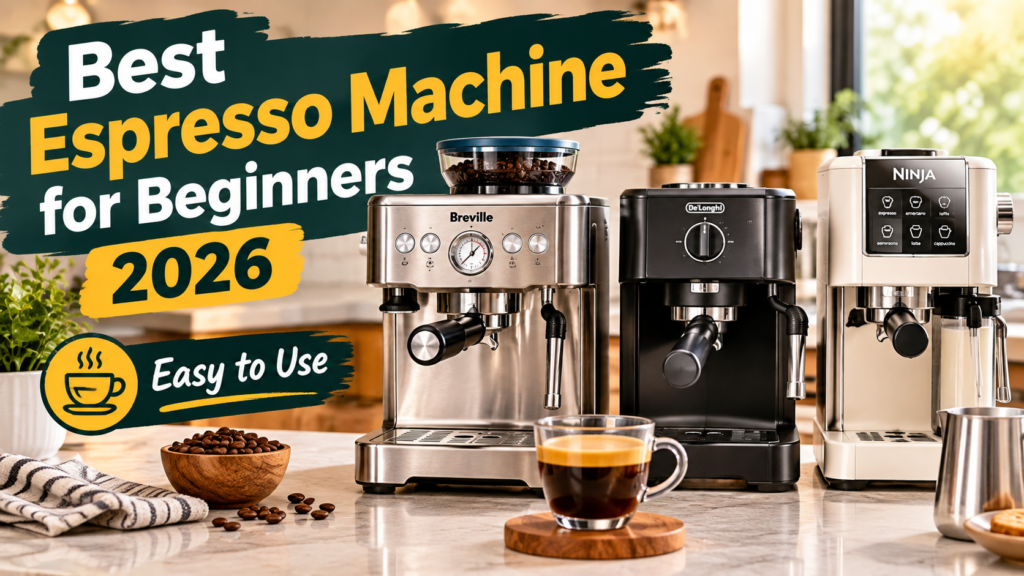
Best espresso machine for beginners in 2026: Discover easy-to-use machines for barista-style espresso, lattes, cappuccinos, and coffee at home.
KitchenLabZone is a reader-supported website. This means that when you click on certain links on our site and make a purchase, we may earn a small commission—at no additional cost to you.
As an Amazon Associate, KitchenLabZone earns from qualifying purchases. These affiliate links help us keep our content free, up-to-date, and helpful for our readers.We only recommend products that we genuinely believe offer value and are relevant to our audience. Our reviews and recommendations are based on research, user feedback, and personal opinions, not influenced by affiliate partnerships.Your support through these links allows us to continue providing high-quality kitchen guides, product reviews, and buying advice.
If you have any questions regarding this disclosure, feel free to contact us.
Thank you for supporting KitchenLabZone!
KitchenLabZone is a reader-supported website. As an Amazon Associate, KitchenLabZone earns from qualifying purchases at no additional cost to you.
“I want café-style espresso at home, but I don’t know which machine is actually easy enough for a first-time user.”
If that’s roughly what brought you here, you’re not alone — and you’ve probably already noticed the problem. Search “best espresso machine for beginners” and you’ll get a flood of machines with different terms: PID, thermoblock vs. thermocoil, pre-infusion, 54mm vs. 58mm portafilters, 15-bar vs. 20-bar pumps. Some guides push you toward a $2,000 dual-boiler prosumer machine. Others hand you a $40 stovetop “espresso maker” that isn’t really espresso at all.
None of that helps you answer the actual question: which machine will let you, specifically, make good espresso without a steep learning curve or a pile of regret?
This guide skips the generic listicle approach. Instead of ranking machines by star count, we’re matching machine types to the kind of beginner you actually are — because “beginner-friendly” means something different depending on whether you want zero effort, you want to learn real skills, or you’re trying to keep your first setup under $150.
Quick Overview
Best for easiest learning (automatic milk, no grinder needed on day one): Breville Bambino Plus
Best all-in-one with a built-in grinder: Breville Barista Express Impress
Best compact footprint: Breville Bambino
Best budget entry point: De’Longhi Stilosa
Best for learning real hands-on espresso skills: Gaggia Classic Evo Pro
Best for minimal daily effort (grinder + auto milk in one machine): Ninja Luxe Café Mini Plus

- #1 Worldwide Espresso Machine Maker* *Independent Research Institute, Sales Leader, Full Year 2025
- OPTIMAL EXTRACTION: Achieve expertly pulled shots of espresso with a consistent 9-bar high pressure extraction and an au…
- PERFECT TEMPERATURE: Instantly reach the perfect temperature, thanks to Thermoblock technology, providing fast, precise,…
Comparison Table

- #1 Worldwide Espresso Machine Maker* *Independent Research Institute, Sales Leader, Full Year 2025
- Contemporary and Compact Design: The perfect addition to your modern kitchen counter top, without taking up too much spa…
- Manual Milk Frother: Texture your milk with ease to create an authentic cappuccino, latte or flat white.

- 【NO MORE CLOGS, JUST 30 LEVELS OF FREEDOM】 Tired of grinder jams? Our upgraded Anti-Clog System features a polished path…
- 【SAVOR EVERY SIP, EFFORTLESSLY】 Why settle for average? Experience rich, café-quality expresso coffee machines at home. …
- 【THE SECRET TO THICK CREMA】 Consistency is key. Our 20 Bar High-Pressure pump extracts maximum aroma and depth from ever…

- OPTIMAL EXTRACTION: Achieve expertly extracted espresso with a 15-bar Italian professional pump delivering the perfect p…
- PERFECT TEMPERATURE: Instantly reach the perfect temperature, thanks to Thermoblock technology, providing fast, precise,…
- ADJUSTABLE FROTHER: Frothing milk and alternatives is simple and easy, with an adjustable 2-setting steam wand from silk…

- BE YOUR OWN BARISTA: Café-quality espresso shouldn’t require a PhD. The Ninja Luxe Cafe Premier is a 3-in-1 machine desi…
- 3 MACHINES IN 1: Includes 2 Espresso Styles — double shot or quad shot, 3 Drip Coffee Styles—classic, rich or over ice, …
- HANDS-FREE FROTHING: Dual Froth System combines a spinning whisk with automatic steamer to produce perfect, silky-smooth…
| Machine | Best For | Grinder | Milk System | Ease of Use | Footprint | Approx. Price* |
|---|---|---|---|---|---|---|
| Breville Bambino Plus | Easiest real espresso for a first machine | No — pair with a separate burr grinder | Automatic steam wand (hands-free) | Very easy | Compact (7.7″ wide) | ~$500 |
| Breville Bambino | Smallest counter footprint, learning manual steaming | No | Manual steam wand | Easy, some milk-steaming practice needed | Very compact (7.75″ wide) | ~$300 |
| Breville Barista Express Impress | All-in-one with grinder, minimal mess | Yes — integrated conical burr, 25 settings | Manual steam wand | Easy-moderate (assisted tamping removes the hardest step) | Medium (13″ x 12.5″ x 16″) | ~$750–$900 |
| De’Longhi Stilosa | Lowest-cost genuine entry point | No | Manual steam wand | Easy, but least forgiving on technique | Compact | ~$100–$150 |
| Gaggia Classic Evo Pro | Learning real barista technique with commercial-style parts | No | Manual, commercial-style steam wand | Moderate — rewards learning | Medium | ~$450–$550 |
| Ninja Luxe Café Mini Plus | Zero-guesswork all-in-one | Yes — built-in with scale | Automatic, hands-free (3 froth presets) | Very easy | Medium (12.2″ x 10.2″ x 13.4″) | ~$500 |
*Prices are manufacturer list prices verified at the time of writing and change frequently with sales. Always check the current price before buying.
(See Amazon for current stock and pricing — search each model name directly, as availability and specific colorways rotate.)
For a wider look at everyday drip and pod machines, our best coffee makers for daily use guide covers non-espresso options, and if counter space is your main constraint, our best coffee makers for small kitchens roundup is worth a look too.
What Makes an Espresso Machine Beginner-Friendly?
Espresso is a high-pressure, low-tolerance brewing method. Unlike a drip coffee maker, where a slightly off measurement barely changes the cup, espresso amplifies small mistakes — grind size, dose, and tamp pressure all compound into a shot that’s either syrupy and rich or sour and thin.
A genuinely beginner-friendly machine doesn’t eliminate that reality. It reduces the number of variables you have to manage while you’re still learning. That generally comes down to a handful of things:
- Fast, stable heating. Thermoblock and ThermoJet-style systems heat in seconds rather than minutes, so you’re not standing around, and they hold temperature steadily enough that shot-to-shot consistency isn’t a battle.
- Simple, labeled controls. One or two buttons for a single or double shot beats a menu system you have to memorize.
- Pre-infusion. A brief low-pressure soak before full pressure kicks in helps the puck saturate evenly, which forgives minor tamping inconsistencies.
- A steam wand you can actually use. Either automatic (the machine handles temperature and texture for you) or manual with enough power to make decent microfoam without 15 minutes of practice.
- Forgiving portafilter baskets. Many beginner machines ship with pressurized baskets that produce a reasonable shot even with slightly inconsistent grind — a real training-wheels feature, even if serious enthusiasts eventually move away from them.
None of that requires you to spend $1,000. It just requires knowing what you’re prioritizing.
Best Espresso Machines for Beginners in 2026
Breville Bambino Plus
- #1 Worldwide Espresso Machine Maker* *Independent Research Institute, Sales Leader, Full Year 2025
- OPTIMAL EXTRACTION: Achieve expertly pulled shots of espresso with a consistent 9-bar high pressure extraction and an au…
- PERFECT TEMPERATURE: Instantly reach the perfect temperature, thanks to Thermoblock technology, providing fast, precise,…
Best for: Beginners who want the easiest path to a genuinely good espresso and latte, without learning to steam milk by hand.
The Bambino Plus is built around Breville’s ThermoJet heating system, which gets the machine to brewing temperature in about three seconds — a real difference if you’re used to machines that need a 15-minute warm-up. The controls are two buttons (single/double shot) plus a steam button, so there’s no menu to navigate.
The standout beginner feature is the automatic steam wand: you fill the included milk jug, press a button, and the machine handles milk temperature and microfoam texture for you across a few adjustable presets. That single feature removes the hardest skill in home espresso — manual milk texturing — from the learning curve entirely.
It doesn’t include a grinder, so budget for a separate burr grinder (see the grinder section below). The 64 oz / 1.9L water tank is generous for its size, and at 7.7 inches wide it tucks under most upper cabinets.
Pros:
- Heats in about 3 seconds
- Hands-free automatic milk frothing with adjustable temperature/texture
- Compact footprint fits small kitchens
- 54mm portafilter with dose control tools included
Cons:
- No built-in grinder — factor in that additional cost
- Water tank is on the smaller side for daily multi-cup use
- Included tamper is basic; many owners upgrade it
Who should buy it: Anyone who wants a real semi-automatic machine, cares about milk drinks, and doesn’t want milk steaming to be their first hurdle.
Who should skip it: Buyers who want the grinder built in, or who specifically want to learn manual steam-wand technique from day one.
[Check Price on Amazon]
Breville Bambino
- #1 Worldwide Espresso Machine Maker* *Independent Research Institute, Sales Leader, Full Year 2025
- Contemporary and Compact Design: The perfect addition to your modern kitchen counter top, without taking up too much spa…
- Manual Milk Frother: Texture your milk with ease to create an authentic cappuccino, latte or flat white.
Best for: The smallest possible countertop footprint, and beginners who want to learn manual milk steaming at a lower price than the Plus.
The standard Bambino shares the Bambino Plus’s fast ThermoJet heating and compact 7.75-inch width, but strips out the automatic steam wand in favor of a manual one. That makes it a genuinely good option if you’re deliberately interested in developing hand-steaming skills, or if the roughly $200 price gap matters more to you than automation.
It ships with both pressurized and unpressurized baskets, timed dosing you can program and save, and a dedicated hot water function for Americanos.
Pros:
- Very small footprint — one of the most compact espresso machines available
- Fast heat-up thanks to the same ThermoJet system as the Plus
- Noticeably less expensive than the Plus
Cons:
- Manual steam wand means a real learning curve for microfoam
- No built-in grinder
- Smaller water reservoir than the Plus (48 oz)
Who should buy it: Beginners on a tighter budget who are willing to spend a little time practicing milk texturing, or anyone with very limited counter space.
Who should skip it: Buyers who specifically want automatic milk frothing — that’s the Plus’s job, not this one’s.
[Check Price on Amazon]
Breville Barista Express Impress
- 【NO MORE CLOGS, JUST 30 LEVELS OF FREEDOM】 Tired of grinder jams? Our upgraded Anti-Clog System features a polished path…
- 【SAVOR EVERY SIP, EFFORTLESSLY】 Why settle for average? Experience rich, café-quality expresso coffee machines at home. …
- 【THE SECRET TO THICK CREMA】 Consistency is key. Our 20 Bar High-Pressure pump extracts maximum aroma and depth from ever…
Best for: Beginners who want a true all-in-one machine — grinder included — without hand-tamping being the thing that trips them up.
This is Breville’s answer to the most common all-in-one complaint: built-in grinders are convenient, but manual tamping is one of the harder skills to get consistent. The Impress Puck System handles dosing and tamping for you, applying a consistent amount of pressure with a barista-style finishing twist, and it learns from your last grind to auto-correct future doses.
Under the hood, you get a 25-setting integrated conical burr grinder, PID temperature control targeting 93°C, a 9-bar pump with low-pressure pre-infusion, and a 54mm portafilter. It’s a genuinely capable machine — closer to what a barista would recognize as “real” espresso equipment than most beginner machines — just with the trickiest manual step automated.
Pros:
- Built-in burr grinder removes the need for a separate purchase
- Assisted tamping takes out one of the hardest beginner skills
- PID temperature control and pre-infusion for real shot consistency
- Auto-corrects dose based on your last grind/tamp result
Cons:
- Noticeably more expensive than grinder-less options
- Larger footprint since it houses a grinder
- More parts to clean than a simpler machine
Who should buy it: Beginners who want fresh-ground espresso without buying a separate grinder, and who like the idea of a machine that keeps some manual control (grind size, shot timing) while automating the most error-prone step.
Who should skip it: Anyone on a tight first-machine budget, or anyone who’d rather have full manual control over dosing and tamping to build that skill themselves.
[Check Price on Amazon]
De’Longhi Stilosa
- OPTIMAL EXTRACTION: Achieve expertly extracted espresso with a 15-bar Italian professional pump delivering the perfect p…
- PERFECT TEMPERATURE: Instantly reach the perfect temperature, thanks to Thermoblock technology, providing fast, precise,…
- ADJUSTABLE FROTHER: Frothing milk and alternatives is simple and easy, with an adjustable 2-setting steam wand from silk…
Best for: The lowest-cost genuine entry point into real espresso — not a pod machine, an actual portafilter machine.
The Stilosa is a fully manual espresso machine with a 15-bar pump and a stainless steel boiler, list-priced under $150 and frequently discounted to around $100. It’s a legitimately capable “starter” machine in the sense that it will pull a real espresso shot with a portafilter and produce crema — it just asks more of you than the pricier machines on this list. There’s no PID, no pre-infusion, and the steam wand is manual with a single dial controlling brew and steam functions.
This is the machine to buy if your goal is to find out whether you’ll actually use a home espresso setup before spending real money, or if you’re comfortable pairing a budget machine with a quality burr grinder rather than a pricier machine with a mediocre one.
Pros:
- Very low price for a genuine portafilter machine
- Compact and lightweight
- Simple, single-dial control scheme
Cons:
- No pre-infusion or temperature stability features — more shot-to-shot variability
- Manual steam wand with a real learning curve
- No auto shut-off on some versions — check the model before buying
Who should buy it: Budget-conscious first-timers who want to learn on genuine equipment and don’t mind an unforgiving margin for error while they dial things in.
Who should skip it: Anyone who gets discouraged easily by inconsistent early results — the Stilosa asks more patience of a beginner than the Bambino Plus does.
[Check Price on Amazon]
Gaggia Classic Evo Pro
- OPTIMAL EXTRACTION: Achieve expertly extracted espresso with a 15-bar Italian professional pump delivering the perfect p…
- PERFECT TEMPERATURE: Instantly reach the perfect temperature, thanks to Thermoblock technology, providing fast, precise,…
- ADJUSTABLE FROTHER: Frothing milk and alternatives is simple and easy, with an adjustable 2-setting steam wand from silk…
Best for: Beginners who specifically want to learn real barista technique on equipment with genuinely commercial-grade components, and who plan to grow into the hobby rather than stay at “easiest possible.”
The Classic Evo Pro is a single-boiler, dual-use machine made in Italy, built around a 58mm commercial portafilter, a 3-way solenoid valve (which keeps the puck from dripping after a shot), and a 9-bar OPV-regulated pump. None of that is “beginner” in the automated sense — there’s no auto-tamping, no automatic milk system, no PID out of the box. What it offers instead is a machine that behaves like the equipment baristas train on, at a price well below true prosumer gear, with a long track record of being modification- and upgrade-friendly.
This is the pick for the type of beginner who doesn’t want “the easiest possible experience” — they want a machine that will still make sense to own in three years, after they’ve learned to dial in a shot properly.
Pros:
- Commercial-style 58mm portafilter and steam wand
- 3-way solenoid valve for cleaner pucks
- Strong upgrade and modification community/support
- Made in Italy with an established reputation for durability
Cons:
- No built-in grinder, PID, or automated milk system
- Steeper learning curve than the other machines here
- Higher upfront price than the Stilosa or Bambino
Who should buy it: Beginners who see espresso as a skill they want to develop, not just a drink they want to press a button for.
Who should skip it: Anyone who wants milk drinks to be low-effort from day one, or who doesn’t want to spend the first few weeks dialing in technique.
[Check Price on Amazon]
Ninja Luxe Café Mini Plus
- BE YOUR OWN BARISTA: Café-quality espresso shouldn’t require a PhD. The Ninja Luxe Cafe Premier is a 3-in-1 machine desi…
- 3 MACHINES IN 1: Includes 2 Espresso Styles — double shot or quad shot, 3 Drip Coffee Styles—classic, rich or over ice, …
- HANDS-FREE FROTHING: Dual Froth System combines a spinning whisk with automatic steamer to produce perfect, silky-smooth…
Best for: Beginners who want the built-in grinder and the hands-free milk system, with essentially no manual steps beyond loading beans and milk.
The Luxe Café Mini Plus pairs a built-in grinder and precision scale with a hands-free automatic steam wand that offers three froth presets for dairy or plant-based milk. It’s a 2-in-1 machine — it also brews drip-style coffee, hot or over ice — which is useful if not everyone in your household wants espresso every morning. The grinder gives automatic grind-size recommendations, which takes some of the guesswork out of dialing in a new bag of beans.
At roughly 30% smaller than Ninja’s original Luxe Café Pro, it’s reasonably compact for a machine that houses both a grinder and a milk system, though it’s still noticeably larger than a grinder-less machine like the Bambino.
Pros:
- Built-in grinder with automatic grind-size guidance
- Fully automatic, hands-free milk frothing with three presets
- 2-in-1 espresso and drip coffee functionality
- Dishwasher-safe removable parts
Cons:
- Larger footprint than grinder-less compact machines
- Newer to market than some competitors, so long-term reliability data is still limited
- Less manual control than a traditional semi-automatic
Who should buy it: Beginners who want the lowest possible daily effort — bean to cup, hands mostly off — and don’t mind giving up some manual control to get there.
Who should skip it: Anyone who wants to actually learn grind-dose-tamp-extract as a skill, rather than let the machine handle it.
[Check Price on Amazon]
Manual vs. Semi-Automatic vs. Automatic vs. Superautomatic Espresso Machines
| Type | What you do | Learning curve | Customization | Typical price | Who it suits |
|---|---|---|---|---|---|
| Manual (lever) | Control pressure by hand throughout the shot | Steep | Maximum | Wide range, often high-end | Enthusiasts who want full control — rarely a good first machine |
| Semi-automatic | Grind, dose, tamp yourself; machine controls pump pressure and timing | Moderate | High | ~$100–$900 | Most beginners who want to actually learn espresso (the Stilosa, Bambino, Bambino Plus, Barista Express Impress, and Gaggia Classic all fall here) |
| Automatic | Machine controls shot volume/timing via programmed buttons; you still dose and tamp (or the machine assists) | Low-moderate | Moderate | ~$400–$1,000+ | Beginners who want more consistency without giving up all control |
| Superautomatic (bean-to-cup) | Load beans and milk; machine grinds, doses, tamps, brews, and often froths automatically | Very low | Low | ~$500–$2,000+ | Beginners who want zero technique and consistent results across multiple household users |
The honest trade-off: the more the machine automates, the less you’ll develop actual espresso skill, and the narrower your flavor range tends to be. That’s not a bad thing if convenience is genuinely your priority — it’s just worth being clear-eyed about the trade before you buy.
Do Beginners Need an Espresso Grinder?
Yes, in almost every case — and this is the single most under-explained part of buying a first espresso machine.
Espresso needs a much finer, more consistent grind than drip coffee, and it needs that consistency because the water only has 20–30 seconds of contact time under high pressure. A blade grinder produces uneven particle sizes, which causes “channeling” — water finding the path of least resistance through the coffee puck instead of extracting evenly — and channeling is one of the most common reasons a beginner’s shots taste sour, weak, or inconsistent from one pull to the next.
Built-in grinder (Barista Express Impress, Ninja Luxe Café Mini Plus): Convenient, one less purchase, and one less thing to find counter space for. The trade-off is usually less grind-setting range and precision than a good standalone grinder, though both of these particular machines are well regarded for beginner-appropriate consistency.
Separate burr grinder (needed for the Bambino, Bambino Plus, Stilosa, and Gaggia Classic): This is where a lot of first-time buyers under-invest. A dedicated espresso-capable burr grinder typically starts in the $150–$300 range for something genuinely suited to espresso’s fine, consistent grind requirements — significantly more than a basic drip-coffee burr grinder.
Here’s the part competitor guides often gloss over: a modest espresso machine paired with a good grinder will usually out-perform an expensive machine paired with a poor one. Grind consistency has an outsized effect on extraction quality compared to almost any other single variable. If your total budget is fixed, it’s often smarter to buy the Stilosa or Bambino and spend more on the grinder than to stretch for a pricier machine and skimp there.
What Espresso Machine Features Actually Matter for Beginners?
Heat-up speed: ThermoJet-style systems (Bambino, Bambino Plus) heat in seconds; thermocoil and thermoblock systems (Stilosa, most budget machines) take longer but are still reasonably fast; traditional boilers (Gaggia Classic) take the longest but hold temperature more steadily once warm.
Pressure — and why 15-bar vs. 20-bar marketing is misleading: This is worth addressing directly because it’s one of the most common points of confusion. Espresso is extracted at roughly 9 bars of pressure at the puck. A pump rated for 15 or 20 bars isn’t delivering that pressure to your coffee — it’s the maximum the pump can generate, and most machines use an internal valve (an OPV, or over-pressure valve) to regulate the actual brewing pressure down to around 9 bars regardless of the pump’s rated maximum. A “20-bar” machine does not make better espresso than a well-regulated 9-bar machine; in practice, the OPV and overall build quality matter far more than the number printed on the box. Don’t let pump-pressure marketing be a deciding factor.
Pre-infusion: A brief low-pressure soak before full extraction pressure kicks in. It helps water saturate the coffee puck evenly before the high-pressure phase, which is genuinely useful for beginners because it forgives some tamping inconsistency.
PID temperature control: Digitally regulates water temperature far more precisely than a simple thermostat. It mostly matters for shot-to-shot consistency rather than any single shot’s quality — useful, but not a dealbreaker on a first machine.
Steam wand type: Automatic wands (Bambino Plus, Ninja Luxe Café Mini Plus) remove milk-texturing as a skill you need to learn. Manual wands (Bambino, Stilosa, Barista Express Impress, Gaggia Classic) require practice but give you more control over milk texture once you’ve learned it.
Portafilter size: 54mm (Breville machines) and 58mm (Gaggia Classic, most commercial-style machines) are the two common beginner-relevant sizes. Neither is objectively “better” — 58mm is the commercial-equipment standard and has a larger accessory ecosystem; 54mm machines tend to be more compact.
What Else Do You Need for Home Espresso?
| Category | Item | Why |
|---|---|---|
| Essential | The machine | Obviously |
| Essential | A separate burr grinder (if your machine doesn’t include one) | Grind consistency is critical to decent extraction |
| Essential | Fresh whole-bean coffee | Pre-ground coffee stales fast and rarely suits espresso’s fine grind |
| Useful | A scale | Dosing by weight rather than eyeballing it dramatically improves consistency |
| Useful | A proper tamper | Included tampers are often basic; a well-fitted one improves puck evenness |
| Useful | A milk pitcher | If your machine’s included jug is small or awkward |
| Useful | Cleaning tablets and descaling solution | Needed for regular maintenance regardless of machine |
| Optional | A knock box | Cleaner puck disposal, mostly a convenience |
| Optional | A dosing funnel | Reduces grounds mess around the portafilter rim |
| Optional | A bottomless portafilter | Popular for diagnosing extraction issues visually, not required to make good espresso |
If you want an easy way to add better milk texture without committing to a manual steam wand, our best milk frothers guide and our top milk frothers for coffee lovers roundup both cover standalone options that pair well with machines like the Stilosa.
How to Make Your First Espresso
- Use fresh beans. Ideally roasted within the last 2–4 weeks.
- Grind fresh, and fine. Espresso grind is much finer than drip coffee — closer to table salt than sand.
- Dose consistently. Most machines and baskets are designed around roughly 18–20g for a double shot; check your machine’s guidance.
- Tamp evenly. Level, firm, and straight down — inconsistent tamping is a major cause of channeling.
- Lock in the portafilter and start the shot promptly so grounds don’t sit and lose freshness.
- Observe the shot. A double shot generally runs 25–30 seconds and should flow steadily, not spurt or gush.
- Taste it. Sour and thin usually means under-extracted (grind finer, or extend time); bitter and harsh usually means over-extracted (grind coarser, or shorten time).
- Adjust grind size in small increments and re-test — this is “dialing in,” and it’s normal to need several attempts with a new bag of beans.
- Steam or froth milk if you’re making a latte or cappuccino.
- Clean the machine — backflush if applicable, wipe the steam wand immediately after use, and empty the drip tray.
Common Beginner Mistakes
- Buying the machine before thinking about the grinder. As covered above, this is the single biggest predictor of disappointing first results.
- Using stale or pre-ground beans. Espresso is unforgiving of stale coffee in a way drip coffee often isn’t.
- Ignoring grind size as the main lever. Most “bad shot” problems are grind-size problems, not machine problems.
- Inconsistent dosing or tamping. Small variations compound quickly in espresso.
- Skipping the learning phase entirely. Expecting café-quality results on the first attempt with no adjustment is unrealistic even with excellent equipment.
- Neglecting cleaning. Old coffee oils build up fast and affect taste; steam wands need wiping after every single use.
- Buying a machine that’s more complicated than you’ll actually use. A feature-packed machine you find intimidating gets used less than a simple one you understand.
- Chasing “15-bar” or “20-bar” marketing claims. As explained above, this number is largely irrelevant to shot quality.
- Ignoring countertop space and cabinet clearance, especially for machines with steam wands that need vertical room to lift.
- Forgetting ongoing costs — beans, filters, descaling solution, and eventually a grinder upgrade all add up beyond the machine’s sticker price.
How Much Should a Beginner Spend on an Espresso Machine?
Under $200: Genuine manual portafilter machines exist here (the Stilosa, for example), but expect no pre-infusion, no temperature stability features, and a real learning curve. You will also need to budget separately for a grinder if you want fresh-ground shots.
$200–$400: This range includes compact, well-regarded semi-automatics like the standard Bambino. Still grinder-less at this tier in most cases.
$400–$700: Where automatic milk systems (Bambino Plus), commercial-style build quality (Gaggia Classic Evo Pro), and true all-in-one grinder+machine combos (Ninja Luxe Café Mini Plus) start to appear.
$700+: All-in-one machines with assisted tamping and integrated grinders (Barista Express Impress) and the entry point for superautomatic bean-to-cup machines.
More money doesn’t automatically mean better espresso — it usually means more automation, more consistency, or a better-quality grinder built in. A well-chosen $150 machine paired with a good grinder can outperform a poorly matched $700 setup.
How to Choose the Right Espresso Machine for Your Kitchen
If you want the easiest possible setup → Ninja Luxe Café Mini Plus or Breville Bambino Plus (skip the grinder purchase with the Ninja; pair the Bambino Plus with a separate grinder).
If you want the smallest footprint → Breville Bambino.
If you want a built-in grinder without manual tamping stress → Breville Barista Express Impress.
If you want to genuinely learn barista skills for the long haul → Gaggia Classic Evo Pro.
If you want the lowest upfront cost → De’Longhi Stilosa (plus a separate grinder if your budget allows).
If minimal cleaning matters most → Machines with fewer removable parts and no grinder (Bambino, Bambino Plus, Stilosa) are generally quicker to maintain than grinder-equipped machines.
If you want room to upgrade later → Gaggia Classic Evo Pro’s 58mm commercial format has the largest accessory and modification ecosystem of the machines here.
Cleaning & Maintenance
Daily: Wipe the steam wand immediately after every use (milk residue hardens fast and clogs the tip), empty and rinse the drip tray, and knock out the used puck.
Weekly: Backflush the group head with water (and a cleaning tablet, on machines that support it) to clear coffee oil buildup, and give the portafilter and baskets a proper soak and scrub.
Descaling: Follow your specific machine’s manufacturer schedule — this varies by water hardness and usage, so check your model’s manual rather than relying on a generic interval.
Milk system: Automatic wands (Bambino Plus, Ninja Luxe Café Mini Plus) often have a self-clean or purge cycle in addition to manual wiping; use it.
Water tank: Rinse periodically and refill with fresh, filtered water if your tap water is hard — mineral buildup is one of the more common causes of premature machine issues.
For model-specific cleaning cycles and descaling instructions, always defer to the manufacturer’s own guidance rather than generic advice, since procedures differ meaningfully between machines.
FAQs
What is the best espresso machine for a beginner? It depends on what kind of beginner you are. For most people who want real espresso without a steep learning curve, the Breville Bambino Plus is a strong starting point. If you want the grinder built in, the Barista Express Impress or Ninja Luxe Café Mini Plus are better fits.
Is an espresso machine hard to use? Semi-automatic machines have a real learning curve — mainly around grinding, dosing, and tamping consistently. Machines with automatic milk frothing and assisted tamping meaningfully lower that curve, but no espresso machine is entirely “set and forget” if you’re using fresh beans.
Do beginners need a separate grinder? Yes, unless your machine has one built in. Grind consistency affects espresso quality more than almost any other variable, and pre-ground coffee is a poor match for espresso even when fresh.
Is the Breville Bambino Plus good for beginners? Yes — it’s one of the more commonly recommended first machines because of its fast heat-up and automatic milk frothing, which removes one of the harder beginner skills from the equation.
Is an espresso machine worth it for beginners? If you regularly buy café espresso drinks, a home setup usually pays for itself over time, and most beginners find the learning process genuinely enjoyable. It’s a bigger up-front commitment than drip coffee, though.
What is the easiest espresso machine to use? Machines with automatic milk frothing and either a built-in grinder or forgiving pressurized baskets — the Bambino Plus and Ninja Luxe Café Mini Plus are the closest to “press button, get espresso” on this list.
How much should a beginner spend on an espresso machine? Realistically, budget $250–$700 for the machine, and don’t forget a grinder if the machine doesn’t include one — total first-setup costs commonly land between $400 and $900 once you factor that in.
Is a 15-bar espresso machine better than a 9-bar one? No — actual espresso extraction happens at roughly 9 bars regardless of what the pump is rated for. Higher bar ratings on the box are a marketing figure, not a quality indicator.
What espresso machine is best for lattes? Machines with automatic steam wands make lattes noticeably more approachable for beginners — the Bambino Plus and Ninja Luxe Café Mini Plus both fit this well.
What is the easiest espresso machine to clean? Simpler, grinder-less machines with fewer removable parts (Stilosa, Bambino, Bambino Plus) are generally quicker to clean day-to-day than all-in-one machines with integrated grinders.
Can beginners make café-style espresso at home? Yes, with some practice. Expect your first week or two of shots to be inconsistent while you dial in grind size and technique — that’s normal, not a sign of a bad machine.
What accessories do I need with an espresso machine? At minimum: fresh beans, and a grinder if your machine doesn’t include one. A scale, proper tamper, and milk pitcher are strongly recommended next steps, with cleaning supplies as an ongoing necessity rather than optional.
This guide draws on manufacturer specifications, official product documentation, and comparative analysis of current 2026 beginner espresso machines. It does not represent hands-on lab testing by KitchenLabZone. Prices and availability are subject to change — always verify current pricing before purchasing.
Article Metadata
1. SEO Title: Best Espresso Machine for Beginners in 2026: Easy-to-Use Machines for Barista-Style Coffee
2. Meta Description: Confused by grinders, bars, and jargon? Our 2026 guide matches the best espresso machine for beginners to your budget, space, and skill goals — with real specs, no hype. (157 characters)
3. URL Slug: /best-espresso-machine-for-beginners-2026/
4. Featured Image Concept: A warm, modern kitchen counter scene with 3–4 recognizable compact espresso machines (silhouettes suggestive of a Breville-style and a manual portafilter-style machine) arranged together, a single espresso cup with visible crema in the foreground, soft natural window light, clean premium affiliate-blog aesthetic, bold readable headline text overlay reading “Best Espresso Machines for Beginners 2026.” No brand logos, no misleading claims about specific tested products.
5. Image Alt Text: Best espresso machines for beginners 2026 — compact espresso machines on a kitchen counter with a fresh espresso shot and crema
6. Image Filename: best-espresso-machine-for-beginners-2026.jpg
7. Featured Image Prompt: “A warm, softly lit modern kitchen counter with three compact espresso machines of varying generic silhouettes arranged in a row, a white espresso cup with rich golden crema in the foreground, light wood countertop, blurred kitchen background, premium lifestyle photography style, natural window light, no text, no brand logos”
8. Suggested Social Media Hook: “15-bar” doesn’t mean better espresso — and the machine matters less than the grinder. Here’s how to actually pick your first espresso machine in 2026. ☕
9. Internal Links Used:
- https://kitchenlabzone.com/best-coffee-makers-2026/ (anchor: “best coffee makers for daily use”)
- https://kitchenlabzone.com/best-coffee-makers-small-kitchens-2026/ (anchor: “best coffee makers for small kitchens”)
- https://kitchenlabzone.com/best-milk-frothers-2026/ (anchor: “best milk frothers”)
- https://kitchenlabzone.com/milk-frothers-2026/ (anchor: “top milk frothers for coffee lovers”)
⚠️ Note: I was not able to independently verify these four URLs are live — kitchenlabzone.com blocks automated fetching (robots.txt disallow) and returned no indexed results in search. Please confirm these pages exist and are published before the article goes live; if any URL is dead or the anchor topic doesn’t match an existing page, remove or update that link.
10. External Sources Used:
- Breville official product page (Bambino Plus): https://www.breville.com/en-us/product/bes500
- Breville / Seattle Coffee Gear spec sheet (Bambino): https://www.seattlecoffeegear.com/products/breville-bambino-espresso-machine
- De’Longhi official product page (Stilosa): https://www.delonghi.com/en-us/stilosa-espresso-machine-ec260bk/p/EC260BK
- SharkNinja official product page (Luxe Café Mini Plus): https://www.sharkninja.com/ninja-luxe-cafe-mini-plus-autofroth-espresso-machine/ES351.html
- Specialty Coffee Association, Coffee Standards reference: https://sca.coffee/s/Coffee-Standards-1.pdf
⚠️ Note on additional sources: Gaggia’s and Breville’s (Barista Express Impress) official U.S. product pages were referenced via retailer-mirrored specification pages during research (their content matched across multiple authorized retailers), but I did not obtain a direct, fetchable URL to Gaggia’s own site or Breville’s Barista Express Impress page in this session — please swap in the live official URLs before publishing if you want every link to be a first-party manufacturer page.
Amazon links: Per the brief’s instruction not to invent Amazon URLs, I’ve left “[Check Price on Amazon]” as placeholder CTAs rather than fabricate links. I confirmed one live Amazon listing during research — the De’Longhi Stilosa (ASIN B08C96BG9H) — but did not confirm current ASINs for the other five products in this session. Please insert your own verified, affiliate-tagged Amazon links for each product before publishing.