
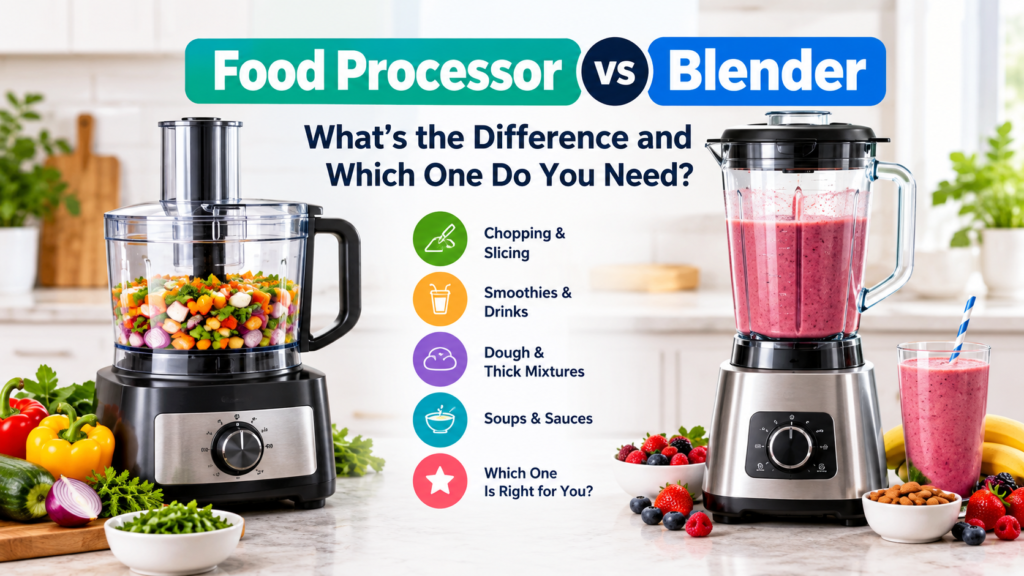
Food processor vs blender: compare their uses, key differences, pros and cons, and discover which kitchen appliance is best for your cooking needs.
KitchenLabZone is a reader-supported website. This means that when you click on certain links on our site and make a purchase, we may earn a small commission—at no additional cost to you.
As an Amazon Associate, KitchenLabZone earns from qualifying purchases. These affiliate links help us keep our content free, up-to-date, and helpful for our readers.We only recommend products that we genuinely believe offer value and are relevant to our audience. Our reviews and recommendations are based on research, user feedback, and personal opinions, not influenced by affiliate partnerships.Your support through these links allows us to continue providing high-quality kitchen guides, product reviews, and buying advice.
If you have any questions regarding this disclosure, feel free to contact us.
Thank you for supporting KitchenLabZone!
By [ADD AUTHOR NAME] | Last updated October 24, 2026
Affiliate disclosure: KitchenLabZone is reader-supported. If you buy through links on this page, we may earn a commission from Amazon at no extra cost to you. As an Amazon Associate, KitchenLabZone earns from qualifying purchases. We did not hands-on test the appliances in this guide. It draws on manufacturer information and published expert guides, which we link where they support a point.
A food processor and a blender look alike: a motor base, a container, a spinning blade. They are built for different jobs, though. A food processor is for food you want to chop, slice, shred, or knead. A blender is for food you want to drink or pour. If you can only buy one, pick the appliance that solves the kitchen task you do most often. This guide explains how each one works, where they overlap, and which fits your cooking, your counter, and your budget.
Quick Overview
- Best for chopping, slicing, shredding, and dough: food processor.
- Best for smoothies, liquid mixtures, soups, and frozen drinks: blender.
- Best for thick mixtures (hummus, nut butter, pesto): it depends on the recipe and the machine’s design.
- Best if you regularly do both kinds of tasks: own both, or research a combo system carefully.
- Best choice when buying only one: the one that fixes your most frequent kitchen problem, not the one with the most attachments.
Food Processor vs Blender at a Glance

- TWO BOWLS, ENDLESS VERSATILITY: Includes two bowls, a 14 cup food processor bowl for large batches of food and a 4 cup m…
- EASY STACK & SNAP ASSEMBLY: The days of struggling to assemble your food processor are over. Each piece of this easy-to-…
- SLICE, SHRED, CHOP, PUREE AND KNEAD: 4 attachments included: a reversible slicing/shredding disc, 2 stainless steel chop…
On mobile, swipe the table sideways to see every column.
| Feature | Food Processor | Blender |
|---|---|---|
| Main design | Wide work bowl, a processing blade, and often slicing or shredding discs | Tall, narrow jar with a fixed blade assembly at the bottom |
| Best tasks | Chopping, slicing, shredding, dough, thick or chunky mixtures | Smoothies, liquid mixtures, soups, sauces, purees, frozen drinks |
| Liquid handling | Limited by bowl design and fill lines; check your manual | Generally better suited to liquids |
| Texture | Chopped, shredded, coarse, or thick | Usually smoother and more uniform in liquid recipes |
| Attachments | May include slicing and shredding discs and a dough blade | Usually a fixed blade; some systems add extra cups or bowls |
| Controls | Often on, off, and pulse | Often multiple speeds, and sometimes preset programs |
| Cleanup | More parts: bowl, lid, pusher, blades, discs | Jar, lid, and blade assembly; some models have a self-clean cycle |
| Storage | Often wider and bulkier, with loose discs to store | Depends on the model; tall jars may not fit under cabinets |
| Best buyer | Frequent meal preppers and solid-food cooks | Smoothie, soup, and drink makers |

- 【28000 RPM High-Speed Blending with 1800W Motor】Experience professional-grade power with an 1800W motor and 6-point stai…
- 【Large 70 Oz BPA-Free Container 】Family-Sized for Convenient Blending – This spacious, food-grade 70 oz pitcher is ideal…
- 【Family-Sized Blending & Portable Convenience】 Designed for family meals and gatherings, our spacious 70 oz BPA-free pit…
The table shows general tendencies, not guarantees. Individual models vary a lot in power, capacity, and attachments, and some high-powered blenders and well-equipped food processors overlap in what they can do. Treat the table as a starting point, then check the manual for the model you are considering.
How Each Appliance Works
How a food processor works
A food processor has a wide, fairly shallow work bowl and a large S-shaped blade that sits low on a central shaft. Slicing and shredding discs, when included, sit higher in the bowl under the feed tube, so you push food down the tube and it falls through the disc as it spins (KitchenAid explains the disc and blade layout). Most models have simple controls, usually on, off, and pulse (Food Network). Because the blade is large and the bowl is wide, food gets cut in pieces rather than pulled into a smooth vortex.
How a blender works
A blender has a tall, narrow jar with a smaller blade at the bottom. That shape pulls ingredients down toward the blade again and again, which is why blenders excel at smooth results. America’s Test Kitchen makes the same point in its comparison of whether you need both appliances: food in a blender jar keeps circulating past the blades, while food in a wide processor bowl meets the blade less often, so purees come out coarser. Blenders usually need some liquid to work well, and they often offer several speeds or preset programs (Tom’s Guide).
What a Food Processor Does Best
A food processor is a prep-work appliance. It does these jobs well:
- Chopping and mincing onions, peppers, carrots, celery, nuts, and herbs, with pulse control to stop at the texture you want.
- Slicing and shredding vegetables and cheese with discs, which works like a mandoline or box grater for large quantities.
- Dough: many models can knead pizza or bread dough and cut cold butter into flour for pie crust. Food Network notes the standard S-blade is enough for many of these jobs.
- Thick or chunky mixtures: pesto, tapenade, chunky salsa, bean dips, and coarse nut mixtures.
- Odd jobs: bread crumbs, riced cauliflower, and mincing raw meat in short pulses (KitchenAid).
The trade-offs are noise, more parts to wash, and a wider footprint. Models also differ widely in bowl size, disc selection, and power, so confirm what comes in the box.
What a Blender Does Best
- 【28000 RPM High-Speed Blending with 1800W Motor】Experience professional-grade power with an 1800W motor and 6-point stai…
- 【Large 70 Oz BPA-Free Container 】Family-Sized for Convenient Blending – This spacious, food-grade 70 oz pitcher is ideal…
- 【Family-Sized Blending & Portable Convenience】 Designed for family meals and gatherings, our spacious 70 oz BPA-free pit…
A blender is built for anything you can drink or pour, or eat without chewing:
- Smoothies and protein shakes, especially with leafy greens or frozen fruit.
- Soups, sauces, and dressings, where silky and emulsified matters.
- Frozen drinks and crushed ice, if the model is designed for ice.
- Loose batters such as pancake or crepe batter, as long as you avoid overmixing (Food Network).
- Nut milks, and in powerful models, nut butters made in smaller batches with a tamper.
A safety note on hot liquids. Steam builds pressure inside a closed jar. Food Network advises removing the center cap, covering the opening with a towel, and starting on low when blending hot liquids in a standard blender. Some high-speed blenders handle hot ingredients and others do not, so follow your model’s manual. Some manufacturers advise against hot liquids altogether.
Food Processor vs Blender: Real-World Task Comparison
| Task | Usually the better fit | What to know |
|---|---|---|
| Chopping onions and vegetables | Food processor | Pulse for control. A blender tends to release liquid and is hard to monitor. |
| Slicing, shredding, grating | Food processor | Depends on included discs. |
| Smoothies and shakes | Blender | The narrow jar keeps food moving into the blade. |
| Milkshakes and frozen drinks | Blender | Check that your model is rated for ice. |
| Soups, sauces, dressings | Blender for silky texture | A processor works for chunky versions. |
| Hummus | Either | Processor is easier to scrape and control; blender can be smoother. |
| Pesto | Often a food processor | Keeps texture; a blender can turn it paste-like. |
| Nut butter | Depends | Processors are common choices; strong blenders need small batches and a tamper. |
| Pizza or bread dough | Food processor | Standard blender jars are not designed to knead. |
| Pie dough | Food processor | Pulse cold fat into flour. |
| Weekly meal prep | Food processor | Large bowls and discs save time. |
Chopping vegetables
This is where the two appliances differ most. A blender can technically chop small batches, but KitchenAid notes it releases more liquid, changes the texture, and runs so fast that it is easy to overshoot. A food processor’s slower, larger blade and pulse button give you control. If this is your main reason for buying, see our guide to the best food processor for chopping vegetables.
Smoothies and frozen drinks
Blenders win here. Their jar shape and speed give smoother results, and many are designed for ice. Food processors tend to leave smoothies coarser and can leak if you overfill them with liquid. Manufacturers often advise against ice in a processor. Our Ninja BN601 guide notes that Ninja does not recommend it, and you should check your own manual. If single servings are your goal, a compact model may be enough. Our guide to the best personal blenders covers that category.
Hummus, pesto, and nut butter
These thick mixtures are where the overlap is greatest. KitchenAid says either appliance can make hummus, and Food Network leans toward the processor for dips, pesto, and nut butter because it blends efficiently and is easier to scrape clean. For a very smooth hummus, a blender with enough liquid may give a silkier result. High-powered blenders can make nut butter, but KitchenAid advises small batches and a tamper. Results depend on the recipe, quantity, and machine.
Dough and baking
Processors handle pizza dough, bread dough, and pie dough well on many models, but heavy doughs strain small motors. Check the manual for maximum dough quantities. Do not expect a blender to knead; none of the guides we reviewed recommend it.
Can One Appliance Replace the Other?
Can a food processor replace a blender?
Partly. A processor can puree soups, sauces, and dips, but the texture is coarser and the bowl is not designed for large volumes of thin liquid. It will not make a good frozen drink. If you rarely make smoothies and mostly want chunky results, a processor can cover occasional pureeing.
Can a blender replace a food processor?
Also partly. A blender can chop in small batches, grind nuts, and puree, and a powerful one can handle some thick mixtures. It cannot slice, shred, or knead, and KitchenAid notes raw meat wraps around the blades. If you cook from scratch daily, you will probably feel the gap.
Where they overlap
The overlap includes hummus, smooth dips, emulsified dressings, some nut butters, and rough purees. For these, choose by texture: processor for chunky or controlled, blender for silky.
Which One Should You Buy?
- Beginners: choose by the dish you want to make first. A smoothie habit points to a blender. A habit of cooking from scratch points to a processor.
- Families: a larger-capacity processor reduces batching for slaws, shredded cheese, and doughs. A full-size blender helps with soups and shakes for several people.
- Small kitchens: pick the one you will use weekly, or consider a compact combo. Food Network suggests an immersion blender paired with a mini processor attachment for tight spaces, with the trade-off of smaller capacity.
- Frequent meal preppers: food processor, with discs and a large bowl.
- Smoothie, soup, and drink fans: blender.
- Serious home cooks: many end up with both. America’s Test Kitchen frames it as depending on whether you live on smoothies or want faster dinner prep and dough.
Budget, Capacity, Cleanup, and Storage
Budget. Prices for both appliances span a wide range, and a higher price does not guarantee a better fit for your habits. Tom’s Guide’s advice holds up: buy only what you will use, because an expensive machine that gathers dust is poor value. If you are shopping for a processor on a budget, see our best food processors under $200.
Capacity. KitchenAid says food processor bowls typically run from about 6 to 14 cups, while blenders range from around 2 cups for personal models to roughly 14 cups for large ones. Check the maximum fill line, which can be lower than the listed jar size. For example, a retailer listing for one Ninja system describes a 72-ounce pitcher with a 64-ounce maximum liquid capacity.
Cleanup. A blender is often easier: Tom’s Guide describes adding soap and water and running it for 10 to 20 seconds. Processors have more parts, including bowl, lid, pusher, blades, and discs. Some models offer dishwasher-safe parts and a few have a self-clean cycle, so check the manual.
Storage. Measure your cabinet height. For example, Vitamix lists the VX1 at about 19.6 inches tall and 12.6 pounds, which will not fit under every cabinet. Some processors store blades and discs inside the bowl, which helps with clutter.
Are Food Processor and Blender Combos Worth It?
Combos bundle one motor base with a blender pitcher and a processor bowl. Some systems, such as Ninja’s Professional Plus Kitchen System, also add single-serve cups. They can save space and money. The catch: Tom’s Guide’s reviewer found combos do not perform as well as dedicated machines, and combo parts mean more pieces to wash and store.
A combo may be worth it if you have limited space, do both tasks occasionally, and are fine with moderate capacity. Skip it if you bake dough often, cook large batches, or blend daily, because a single motor shared between jobs can be a compromise. Read the manual for liquid limits, dough limits, and whether ice is allowed in each container.
What to Check Before Buying
- Rated power vs. peak power. Peak figures are marketing numbers; compare rated wattage where available.
- Capacity and fill lines, not just the headline cup size.
- Blades and discs included: a dough blade, two slice thicknesses, and a shred disc add flexibility.
- Pulse control, especially for chopping.
- Hot-liquid and ice guidance in the manual.
- Feed tube width, which reduces pre-cutting.
- Dishwasher-safe parts and how many pieces you will wash.
- Size and weight, including height under your cabinets.
- Warranty and replacement part availability.
- Noise: both appliances can be loud, and short run times help.
Product Recommendations for Different Needs
These are product categories matched to common buyer needs, based on manufacturer specifications and information on our other guides. They are not our own test results. Check current prices and availability on Amazon before buying.
A dependable full-size food processor: Cuisinart Pro Custom 11
An 11-cup bowl, a 625-watt motor, an extra-large feed tube, and slicing and shredding discs make this a practical family and meal-prep machine. Buy it if you cook for four or more or prep in batches. Skip it if your counter or cabinet space is tight. For more options, see our best food processors in 2026.
A budget-friendly food processor: Ninja Professional Plus (BN601)
A 9-cup bowl, a dough blade, and preset programs make this a flexible starter machine. Ninja rates the motor at 850 watts and markets it at 1,000 peak watts. Buy it if you want everyday chopping, shredding, and occasional dough without spending much. Skip it if you want several slicing thicknesses, since it includes one reversible disc.
A high-powered blender: Vitamix VX1
Vitamix lists the VX1 at 2.2 peak horsepower and 1,440 watts, with a 64-ounce container, a tamper, a self-cleaning program, variable speed, pulse, and a five-year limited warranty. Buy it if you blend daily and want smoother soups, frozen blends, and thicker mixtures. Skip it if you blend occasionally, have low cabinets, or want a single-serve cup.
A personal blender for single servings: nutribullet Pro 900
The 900-watt nutribullet Pro 900 comes with 32-ounce and 24-ounce cups, and it is one of the models in our personal blender guide. Buy it if you make one smoothie at a time and want to save counter space. Skip it if you need to crush ice often or blend hot ingredients, since reviewers note it is not designed for that without added liquid.
A food processor and blender combo: Ninja Professional Plus Kitchen System
Retailer listings for the BN801 describe a 72-ounce pitcher, two single-serve cups, and an 8-cup processor bowl on one base. Buy it if space is tight and your use is light to moderate. Skip it if you make dough often or need big batches. Confirm current availability and specifications before buying.
[ADD VERIFIED AMAZON AFFILIATE LINK]
Frequently Asked Questions
1. What is the main difference between a food processor and a blender?
A food processor uses a wide bowl with blades and discs to chop, slice, shred, and knead. A blender uses a tall jar with a fixed blade to liquefy and puree.
2. Can a food processor replace a blender?
For chunky soups, dips, and rough purees, yes. For silky smoothies, thin liquids, and frozen drinks, usually no.
3. Can a blender replace a food processor?
Only for small-batch chopping, grinding, and some thick mixtures. A blender cannot slice, shred, or knead dough.
4. Is a food processor or blender better for smoothies?
A blender. Its jar shape keeps ingredients moving into the blade, so smoothies come out smoother.
5. Is a food processor or blender better for chopping vegetables?
A food processor, because pulse control keeps pieces even and prevents mushiness.
6. Can you make dough in a blender?
Not reliably. Standard blender jars are not designed for kneading, so use a food processor with a dough-capable blade or a stand mixer.
7. Can a food processor crush ice?
Often not recommended. Some manufacturers advise against it, so check your manual before trying. A blender rated for ice is the safer choice.
8. Is a blender or food processor better for hummus?
Either works. A processor gives easier control and scraping; a blender can produce a silkier result with enough liquid.
9. Do you really need both appliances?
Not necessarily. If you do mostly one kind of task, one machine may be enough. If you often chop and blend, both make sense.
10. Is a food processor and blender combo worth buying?
It can be if you have limited space and light-to-moderate use. Heavy bakers and daily smoothie makers may prefer separate machines.
Final Verdict
Choose a food processor if you chop, slice, shred, or make dough regularly. Choose a blender if your priorities are smoothies, soups, and frozen drinks. If you cook from scratch and make smoothies, plan on owning both, or consider a combo if space is the limiting factor. When buying one, pick based on your most frequent task, check the manual for liquid, ice, and dough limits, and avoid paying for features you will not use.
SEO Deliverables
- SEO title (49 characters): Food Processor vs Blender: Which One Do You Need?
- Meta description (147 characters): Food processor vs blender: learn how they differ, what each does best, where they overlap, and which one fits your home cooking, space, and budget.
- URL slug: food-processor-vs-blender
- Primary keyword: food processor vs blender
- Secondary keywords: food processor vs blender difference; blender vs food processor; food processor or blender; can a food processor replace a blender; can you use a blender as a food processor; food processor vs blender for smoothies; food processor vs blender for chopping vegetables; food processor vs blender for dough; food processor vs blender for hummus; best appliance for meal prep; blender and food processor combo
- WordPress category: Kitchen Appliances (exists on the site at /category/categories/kitchen-appliances/)
- Featured image concept (16:9): A side-by-side of a food processor filled with chopped vegetables and a blender holding a smoothie on a clean modern kitchen counter.
- Image filename: food-processor-vs-blender-comparison.webp
- Alt text: Food processor with chopped vegetables beside a blender with a smoothie on a kitchen counter
- FAQ schema: Not included. Google restricted FAQ rich results to government and health sites in 2023, so the markup is unlikely to produce a rich result here. Verify against Google’s current documentation before adding it, and if you do, the markup must match the visible FAQ exactly.
Internal link placement and anchor text
| Section | Anchor text | URL |
|---|---|---|
| Chopping vegetables | best food processor for chopping vegetables | https://kitchenlabzone.com/best-food-processor-chopping-vegetables-2026/ |
| Smoothies and frozen drinks; personal blender rec | best personal blenders | https://kitchenlabzone.com/best-personal-blenders-2026/ |
| Budget | best food processors under $200 | https://kitchenlabzone.com/best-food-processors-under-200/ |
| Full-size processor rec | best food processors in 2026 | https://kitchenlabzone.com/best-food-processors-2026/ |
Verified external sources used
- Tom’s Guide comparison: https://www.tomsguide.com/face-off/food-processor-vs-blender
- Food Network guide: https://www.foodnetwork.com/how-to/packages/help-around-the-kitchen/blender-versus-food-processor
- KitchenAid comparison: https://www.kitchenaid.com/countertop-appliances/pinch-of-help/difference-between-food-processor-and-blender
- America’s Test Kitchen: https://www.americastestkitchen.com/articles/7243-food-processor-vs-blender-do-you-need-both
- Vitamix VX1 specifications (cited for specs): https://www.vitamix.com/us/en_us/shop/vx1
Verification Report
What I verified
- Opened and read in full: Tom’s Guide (published April 2022), Food Network (August 2020), and KitchenAid’s official comparison (October 2025).
- Opened live KitchenLabZone pages: best-food-processors-under-200 and best-personal-blenders-2026. The other two internal URLs (best-food-processors-2026, best-food-processor-chopping-vegetables-2026) appear in your site’s recent-posts list and are linked from those pages, but I did not open them individually. best-kitchen-gadgets-2026 also exists but was left out as not relevant enough.
- Vitamix VX1 specifications come from Vitamix’s own product page (via search results).
- America’s Test Kitchen was read through a search excerpt, not the full page. Open it before publishing.
What I could not verify
- Good Housekeeping, Serious Eats, and Bon Appétit were blocked in my environment, so I could not read them, did not link them, and did not claim they rank. Replace them with sources you can open, or check them yourself.
- I did not confirm Google rankings. My research used a web search tool, not Google results for your target market, so run the exact queries in your own browser for the competitor-gap check.
- Ninja’s advice against ice in the BN601 comes from your own under-$200 guide, not from Ninja’s manual. Confirm in the manual.
- The BN801 combo details come from retailer listings and may be dated, since one retailer listing showed a related Ninja model as discontinued. Confirm availability and get a real affiliate link.
- The “blenders can’t knead” and “pesto turns paste-like in a blender” statements are editorial judgments that none of the sources contradict, but none states them directly in the pages I read. Soften them if your editor prefers.
- The Google FAQ rich-result change is from my training knowledge and was not re-checked today.
Affiliate links to confirm
- All four Amazon links use the tag-171928-20 links already on your pages. The Cuisinart Pro Custom 11 appears under two different ASINs on your under-$200 page (B01AXN5VUC in the card and B01AXM4VPY in the table). I used the one whose card title matches the product, so check which is correct.
- The combo link is a placeholder. No prices, ratings, or review counts are stated.
Competitor content gaps this article fills
- Tom’s Guide and Food Network are brief on overlap tasks, buyer personas, and combo trade-offs, and Tom’s Guide’s price figures are from 2022.
- Neither covers hot-liquid and ice limits, fill-line versus jar-size confusion, or cabinet-height storage in depth. This article does.
Site issues I noticed while checking links
- The under-$200 page shows a SimplyGoodCoffee brewer card inside food processor sections, and the personal blender page shows mismatched cards (a Vitamix under BlendJet, a Ninja pitcher under Beast products). Both pages also have malformed link markup near the end. These are worth fixing before more traffic goes to them.