
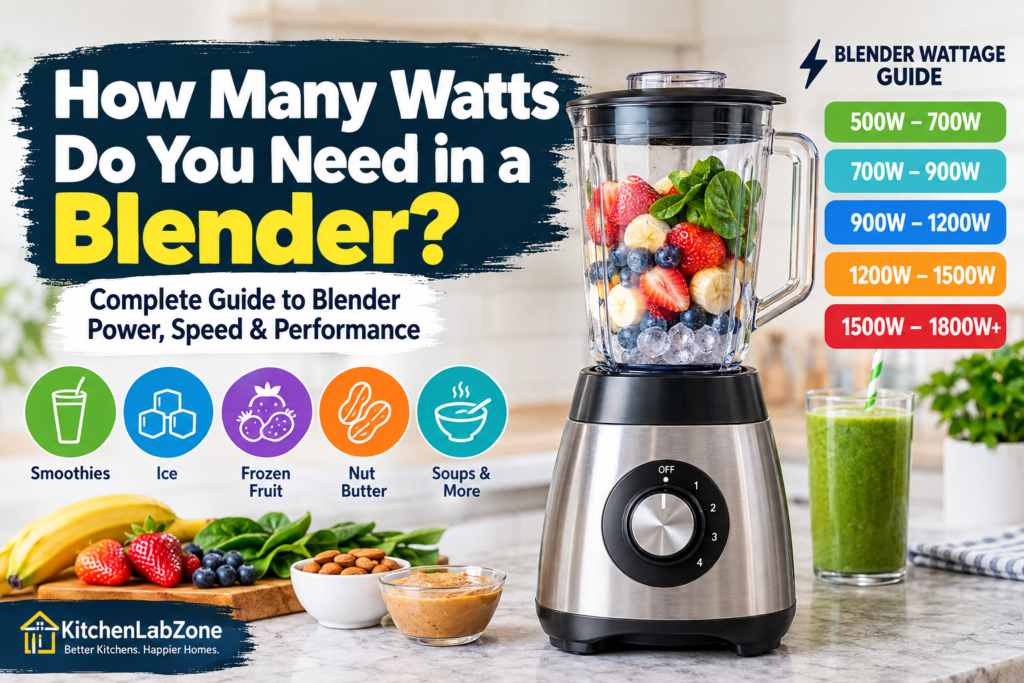
How many watts do you need in a blender? Learn the ideal blender wattage for smoothies, ice, frozen fruit, nut butter, and everyday blending in this complete guide.
KitchenLabZone is a reader-supported website. This means that when you click on certain links on our site and make a purchase, we may earn a small commission—at no additional cost to you.
As an Amazon Associate, KitchenLabZone earns from qualifying purchases. These affiliate links help us keep our content free, up-to-date, and helpful for our readers.We only recommend products that we genuinely believe offer value and are relevant to our audience. Our reviews and recommendations are based on research, user feedback, and personal opinions, not influenced by affiliate partnerships.Your support through these links allows us to continue providing high-quality kitchen guides, product reviews, and buying advice.
If you have any questions regarding this disclosure, feel free to contact us.
Thank you for supporting KitchenLabZone!
If you’ve spent any time comparing blenders, you’ve probably noticed the wattage numbers all over the box: 500W, 700W, 900W, 1200W, even 1800W. It’s tempting to assume the highest number wins. But wattage is only one piece of a much bigger puzzle, and buying based on watts alone is one of the most common — and most expensive — mistakes shoppers make.
This guide breaks down what blender wattage actually means, how many watts you really need for smoothies, ice, frozen fruit, nut butter, and everyday cooking, and why two blenders with the “same” wattage can perform completely differently. By the end, you’ll be able to shop by task instead of by marketing numbers.

- POWERFUL BLENDING: The intuitive 900-peak-watt push-to-blend motor base powers through everything inside the cup to give…
- PRO EXTRACTOR BLADES ASSEMBLY: Easily crushes ice and breaks down whole fruits and veggies to create nutrient extraction…
- BLEND TO-GO: Blend directly in one of the three included 20 oz. Ninja To-Go Cups and then twist on a Spout Lid to enjoy….
Quick Overview
| Question | Quick Answer |
|---|---|
| Best wattage for most home users | 700–1000W covers smoothies, everyday blending, and occasional ice |
| Wattage for smoothies | 500–900W is enough for most fruit and veggie smoothies |
| Wattage for ice and frozen fruit | 900–1200W+ with sturdy blades handles these more reliably |
| Wattage for nut butter | 1200W+ or a high-performance/commercial-style motor works best |
| Does more wattage always mean better performance? | No — blade design, jar shape, and motor control matter just as much |
Ready to compare actual machines instead of just specs? Our best blenders of 2026 roundup narrows things down by real-world use case.
What Does Blender Wattage Mean?
A watt is a unit of electrical power — it measures how much energy the motor draws while running, not how “good” the blender is. Wattage tells you the motor’s electrical input, not the mechanical output that actually reaches the blades.
That distinction matters. A motor’s rated wattage is measured under specific test conditions, and how much of that power turns into usable blending force depends on the motor’s efficiency, the drive coupling, the blade geometry, and how well the jar circulates ingredients back into the blades. Two blenders can share an identical wattage rating and produce noticeably different results because everything downstream of the motor is different.
Think of it like comparing car engines by horsepower alone. A high-horsepower engine bolted into a poorly designed chassis with bad gearing won’t outperform a smaller, well-engineered engine matched to the right transmission and tires. Blenders work the same way: the motor is only one part of the system.
How Many Watts Does a Blender Need?
There’s no single “correct” wattage that applies to every kitchen, and no government or industry standard dictates a minimum. What you actually need depends on:
- What you’re blending (soft fruit vs. ice vs. nuts)
- How much you’re blending (a single serving vs. a family-size batch)
- How smooth you want the result (chunky salsa vs. silky soup)
- How often you’ll push the blender (occasional use vs. daily heavy use)
As a general starting point, most home cooks who make smoothies, shakes, and everyday blends are well served by something in the 700–1000W range. Shoppers who regularly crush ice, blend frozen fruit straight from the freezer, or want to make nut butter should look toward 1200W and above, paired with a motor and blade system built for that kind of resistance.
If you’re specifically shopping for daily smoothie use, our best blender for smoothies in 2026 guide walks through real models at different price points.
Blender Wattage Chart
Use this chart as a general guide, not a strict rulebook. Manufacturers measure and market wattage differently, and a well-engineered lower-wattage blender can outperform a poorly engineered higher-wattage one on the same task.
| Wattage Class | Typical Blender Type | Best Uses | Handles Ice? | Handles Frozen Fruit? | Handles Nut Butter/Thick Mixes? | Ideal Buyer |
|---|---|---|---|---|---|---|
| Under 500W | Compact personal blenders, budget models | Soft fruit smoothies, shakes, thin sauces, single servings | Rarely, and only in small amounts | Limited — soft frozen fruit only | No | Dorm rooms, occasional users, very light blending |
| 500–700W | Personal blenders, entry-level countertop | Everyday smoothies, protein shakes, salad dressings, small batches | Sometimes, in small quantities | Small amounts of soft frozen fruit | Not recommended | Casual users, small households, apartment kitchens |
| 700–900W | Mid-range countertop blenders | Smoothies, soups, sauces, salsa, everyday family blending | Yes, in moderate amounts | Yes, moderate quantities | Occasionally, in small batches | Daily smoothie makers, small families |
| 900–1200W | Higher-powered countertop blenders | Frozen drinks, thicker smoothies, larger batches, soups | Yes, more reliably | Yes, larger quantities | Yes, with patience and a tamper | Families, fitness users, ice-drink lovers |
| 1200–1500W | Performance/prosumer blenders | Nut butter, thick smoothie bowls, hot soup from friction heat, heavy ice loads | Yes, easily | Yes, easily | Yes | Frequent nut-butter makers, meal-preppers, heavy home cooks |
| 1500–1800W+ | High-performance blenders | Commercial-style crushing, large batches, restaurant-style textures | Yes, effortlessly | Yes, effortlessly | Yes, consistently | Serious home cooks, small food businesses, large households |
| High-performance/commercial-style | Professional and commercial-grade machines | Continuous heavy use, restaurants, juice bars, cafes | Yes | Yes | Yes | Commercial kitchens, extremely heavy home use |
Remember: motor design, blade geometry, jar shape, control settings, ingredient quantity, and liquid ratio all affect real-world results. Wattage is a helpful starting filter, not a guarantee.
Wattage by Blending Task
Here’s a more specific breakdown of realistic wattage guidance for common tasks. Again, treat these as reasonable starting points rather than fixed rules — a well-designed blender can outperform these general ranges, and a poorly designed one can underperform them.
- POWERFUL BLENDING: The intuitive 900-peak-watt push-to-blend motor base powers through everything inside the cup to give…
- PRO EXTRACTOR BLADES ASSEMBLY: Easily crushes ice and breaks down whole fruits and veggies to create nutrient extraction…
- BLEND TO-GO: Blend directly in one of the three included 20 oz. Ninja To-Go Cups and then twist on a Spout Lid to enjoy….
| Task | Realistic Wattage Guidance |
|---|---|
| Smoothies (soft fruit, yogurt, milk) | 500–900W |
| Green smoothies (leafy greens, fibrous stems) | 700–1000W, ideally with a tamper or strong vortex |
| Protein shakes | 500–900W |
| Frozen fruit | 900–1200W |
| Crushing ice | 900–1200W+ |
| Frozen drinks/slushies | 1000–1500W |
| Soups (cooked or blender-heated) | 900–1500W |
| Sauces | 500–900W |
| Salsa | 700–1000W |
| Baby food | 500–900W |
| Nut butter | 1200W+ |
| Hummus | 700–1000W |
| Thick smoothie bowls | 1000–1500W |
| Grinding seeds | 700–1000W |
| Grinding nuts | 1000–1500W |
| Everyday blending | 500–900W |
Does More Wattage Mean Better Blender Performance?
Not automatically. Higher wattage generally gives a motor more available power to draw on when it hits resistance — like a wall of ice or frozen fruit — but whether that power translates into a smooth result depends on several other factors working together:
- Blade design: Blade angle, number of blades, and sharpness affect how ingredients are cut versus just pushed around.
- Jar geometry: A jar that funnels ingredients back down into the blades (sometimes helped by a tamper) prevents “dead zones” where food just sits untouched.
- Motor control: Variable speed dials, presets, and pulse functions let you match the right speed to the ingredient instead of relying on brute force alone.
- Batch size and liquid ratio: Overloading a jar or blending with too little liquid can defeat even a powerful motor.
A well-designed 900W blender with a tamper, sturdy blades, and a jar shaped to keep ingredients circulating can outperform a poorly designed 1200W blender with a narrow jar and flat blades. Wattage sets a ceiling on available power; everything else determines how close a blender gets to that ceiling in practice.
Watts vs. RPM vs. Torque
These three terms get used almost interchangeably in marketing, but they measure different things:
- Watts measure electrical power draw — the input.
- RPM (revolutions per minute) measures how fast the blades spin.
- Torque measures rotational force — how much resistance the motor can push through without slowing down.
A blender can have very high RPM but low torque, meaning the blades spin fast in open liquid but bog down the moment they hit ice or frozen fruit. Conversely, a blender with strong torque can push through tough ingredients at a lower RPM and still produce a smooth result.
For example, some high-performance blenders are engineered around very high blade-tip speeds — the Vitamix 5200’s blades have been measured at roughly 37,000 RPM at top speed — which is one reason friction alone can heat ingredients to a near-boil in a few minutes. But high RPM without matching torque and blade design would just spin ingredients around a jar without breaking them down. Speed and force need to work together.
Peak Watts vs. Continuous Watts
This is one of the most misunderstood — and most important — concepts in blender shopping.
Peak watts refer to the maximum power a motor can briefly draw, often for a fraction of a second during startup or under a heavy load spike. Continuous (or rated) watts refer to the power a motor can sustain during normal, ongoing operation.
Manufacturers are not always consistent about which figure they advertise. Some brands market peak wattage prominently — for instance, several Ninja blenders are marketed with figures like “1400 peak watts” printed directly on packaging and product listings — while other brands, including Vitamix, tend to market their motors by horsepower rather than watts at all (the Vitamix 5200, for example, is officially described by Vitamix as a “2 peak horsepower” motor rather than being given a specific wattage figure).
This means two blenders both labeled “1000 watts” may not represent the same real-world power. One might be a continuous rating that the motor can sustain for minutes at a time, while another might be a brief peak spike that the motor cannot maintain under load.
What to do about it:
- Whenever possible, check the manufacturer’s official specification page to see whether a wattage figure is described as peak or continuous.
- Treat “peak watts” claims as a ceiling, not a guarantee of sustained performance.
- Don’t assume a horsepower rating and a wattage rating from two different brands convert cleanly into each other — manufacturers calculate and test these figures differently, and no universal conversion applies across brands.
- POWERFUL BLENDING: The intuitive 900-peak-watt push-to-blend motor base powers through everything inside the cup to give…
- PRO EXTRACTOR BLADES ASSEMBLY: Easily crushes ice and breaks down whole fruits and veggies to create nutrient extraction…
- BLEND TO-GO: Blend directly in one of the three included 20 oz. Ninja To-Go Cups and then twist on a Spout Lid to enjoy….
600W vs. 900W vs. 1200W vs. 1500W vs. 1800W
600W vs. 900W Blender
A 600W blender is generally a good fit for someone who mostly blends soft fruit, yogurt-based smoothies, and thin sauces, and who doesn’t regularly push it with ice or frozen produce. A 900W blender adds meaningful headroom for tougher jobs — frozen fruit, occasional ice, and thicker mixtures — while still working fine for everyday, lighter tasks. If your blending habits are mostly soft ingredients, the extra 300W of a 900W model may go mostly unused; if you frequently add ice or frozen fruit, it’s a worthwhile upgrade.
900W vs. 1200W Blender
The practical difference here shows up mainly with resistance-heavy ingredients. A 900W blender can generally handle moderate amounts of ice and frozen fruit, but may need more time, more liquid, or more pulsing to get a smooth result. A 1200W blender, especially paired with a tamper and well-designed blades, tends to push through those same ingredients faster and with less babysitting. If you’re making frozen drinks or thick smoothie bowls regularly, 1200W starts to feel like the more comfortable choice.
1000W vs. 1500W Blender
The extra power of a 1500W motor becomes genuinely useful for nut butter, very thick mixtures, large batches, and heavy, frequent ice use — tasks where sustained resistance would otherwise slow a 1000W motor down or require multiple shorter blending cycles. For someone whose blending is mostly smoothies, soups, and sauces in moderate quantities, a 1000W blender with good blade design may be entirely sufficient, and the extra 500W may be unnecessary for their actual habits.
1500W vs. 1800W+ Blender
At this level, shoppers should look past the headline wattage entirely. The difference between 1500W and 1800W+ is often smaller in practical, everyday performance than the numbers suggest, because both tiers typically already include strong blade systems, tampers, and motor control designed for heavy use. At this range, differences in jar geometry, noise level, presets, warranty, and build quality often matter more to daily satisfaction than the extra wattage alone.
- POWERFUL BLENDING: The intuitive 900-peak-watt push-to-blend motor base powers through everything inside the cup to give…
- PRO EXTRACTOR BLADES ASSEMBLY: Easily crushes ice and breaks down whole fruits and veggies to create nutrient extraction…
- BLEND TO-GO: Blend directly in one of the three included 20 oz. Ninja To-Go Cups and then twist on a Spout Lid to enjoy….
Personal Blender vs. Full-Size Blender Wattage
Wattage requirements are not directly comparable across blender categories, because the motor’s workload is different in each one.
| Factor | Personal Blender | Standard Countertop Blender | High-Performance Blender |
|---|---|---|---|
| Typical serving size | Single serving (12–32 oz) | Multiple servings (40–72 oz) | Multiple servings (48–96 oz) |
| Motor workload | Smaller jar, less ingredient mass to move | Larger jar, more mass and distance to circulate | Larger jar, engineered for continuous heavy loads |
| Typical wattage | 300–1000W | 500–1200W | 1200W–1800W+ |
| Ideal use case | Individual smoothies/shakes, small batches | Family smoothies, soups, everyday multitasking | Nut butter, large batches, frequent heavy-duty use |
A 700W personal blender and a 700W full-size countertop blender are not doing the same job. The personal blender’s motor only has to move a small volume of ingredients in a narrow cup, so it can produce very smooth results with less raw power. A full-size jar has more mass, more surface area, and typically needs more circulation to avoid dead spots — so the same wattage figure is being asked to do meaningfully more work in a full-size jar. Don’t assume the two are interchangeable just because the spec sheet says the same number.
How Blade Design and Jar Shape Affect Performance
Wattage gets most of the attention, but blade and jar engineering often make the bigger day-to-day difference:
- Blade angle and count: Blades angled to create a vortex pull ingredients downward and back into the blending zone; flat or poorly angled blades can just spin ingredients in place.
- Blade sharpness and material: Hardened stainless steel blades hold an edge longer under tough use like ice and nuts.
- Jar shape: Wider bases or ridged interior walls (sometimes with a hexagonal or non-circular cross-section) disrupt the ingredient “vortex” less and reduce air pockets and dead zones.
- Tamper access: Jars designed to accept a tamper let you physically push thick or frozen ingredients back into the blades without stopping the machine — a major advantage for nut butter and thick smoothies.
This is why a well-designed 900W blender can sometimes outperform a poorly designed 1200W blender on a specific task like frozen fruit: the lower-wattage machine may be circulating ingredients back into the blades more efficiently, while the higher-wattage machine wastes some of its power on ingredients that just sit in a dead zone.
How Much Power Do You Need for Smoothies?
For standard fruit and vegetable smoothies with a liquid base (milk, juice, or water), 500–900W is typically enough, especially if you’re not adding much ice. Green smoothies with fibrous stems and leafy greens benefit from being on the higher end of that range, or from a blender with a tamper, since fibrous plant matter can be tougher to fully break down than soft fruit.
How Much Power Do You Need to Crush Ice?
Ice is one of the tougher tests for a blender because it’s dense, hard, and doesn’t compress. Many buying guides suggest looking for motors in the 900–1200W range or higher when ice crushing is a regular task, paired with sturdy, purpose-built blades. Independent testing organizations like RTINGS run dedicated ice-crushing tests because wattage alone doesn’t reliably predict how fine or “snow-like” the texture will end up — blade design and jar shape play a large role in the final result.
How Much Power Do You Need for Frozen Fruit?
Frozen fruit is generally a bit less demanding than ice cubes because it’s less dense and easier to break down, but it still benefits from more power than soft, room-temperature fruit. A blender in the 900–1200W range, especially one designed with frozen ingredients in mind, will typically produce smoother results with less added liquid than a lower-wattage model. If frozen fruit smoothies are a daily habit, it may be worth exploring our best blender for crushing ice in 2026 guide for models specifically tested against frozen ingredients.
How Much Power Do You Need for Nut Butter?
Nut butter is one of the most demanding tasks a home blender can be asked to do. Nuts are dense, dry, and require sustained grinding to release their oils and turn creamy rather than staying crumbly. This is where high wattage (1200W+), strong torque, and a tamper genuinely matter — lower-wattage blenders often stall out, overheat, or leave the mixture chunky. This is also one of the few tasks where a horsepower-rated, high-performance blender like a Vitamix model tends to outperform lower-powered machines by a wide margin, because the motor is specifically built to sustain heavy resistance without overheating.
Does a Higher-Wattage Blender Use More Electricity?
Wattage represents the rate of power draw, not total energy use. Actual electricity consumption depends on both wattage and how long the blender actually runs.
Here’s a simple way to think about it: a 1000-watt blender running for a full hour would use 1000 watt-hours (1 kWh) of electricity. But most blending jobs only take a minute or two. Running that same 1000-watt blender for 2 minutes uses only about 33 watt-hours — a small fraction of a full kilowatt-hour. In practice, the difference in electricity cost between a 700W blender and a 1200W blender used for a couple of minutes a day is negligible compared to other kitchen appliances that run for hours, like ovens or refrigerators. Wattage is worth knowing for performance reasons far more than for household energy budgeting.
What Wattage Blender Should You Buy?
| User Type | General Wattage Guidance |
|---|---|
| Beginner | 500–900W is plenty to start with |
| Casual smoothie maker | 500–900W |
| Daily smoothie maker | 700–1000W |
| Family of 3–4+ | 900–1200W for larger batches |
| Ice drink lover | 900–1200W+ |
| Frozen fruit user | 900–1200W |
| Green smoothie user | 700–1000W, ideally with a tamper |
| Nut butter maker | 1200W+ |
| Meal-prep user | 900–1500W for larger, thicker batches |
| Small apartment kitchen | A personal blender in the 500–900W range often fits better than a large countertop unit |
| Heavy-duty home cook | 1200–1800W+, high-performance class |
This is guidance based on typical use cases, not a strict ranking — someone who blends occasional smoothies doesn’t need to spend more for a 1500W machine just because it exists. Our best blenders under $200 in 2026 guide is a good next stop if you want strong performance without paying for capability you won’t use.
7 Common Blender Wattage Mistakes
- Assuming more watts automatically means better performance. Blade design, jar shape, and motor control affect results just as much as raw wattage.
- Ignoring peak vs. continuous ratings. A “1400 peak watt” blender and a 1400-continuous-watt blender are not the same thing in daily use.
- Comparing personal and full-size blenders directly. The same wattage figure does different amounts of work depending on jar size and ingredient volume.
- Ignoring blade design. Sharp, well-angled blades can outperform a higher-wattage motor paired with poor blades.
- Ignoring jar shape. A jar that doesn’t circulate ingredients back into the blades creates dead zones no amount of wattage can fix.
- Buying excessive power for simple tasks. If you mostly make soft smoothies, a 1500W+ machine may be overkill and overspend.
- Choosing too little power for ice, frozen ingredients, or thick mixtures. Underpowered motors on these tasks often overheat, stall, or leave chunky results.
Blender Wattage Buying Checklist
- Identify your primary use case (smoothies, ice, frozen fruit, nut butter, soups)
- Match your wattage range to that primary use case, not the highest number available
- Check whether the manufacturer’s spec sheet lists peak or continuous watts
- Compare blade design and jar shape, not just the motor rating
- Consider whether you need a personal blender or a full-size countertop model
- Factor in batch size — cooking for one is very different from cooking for a family
- Look at independent test results where available, not just marketing copy
- Confirm warranty length, since heavy-duty motors are often backed by longer warranties
Frequently Asked Questions
How many watts is good for a blender? For most everyday use — smoothies, sauces, soups, and light frozen ingredients — 700–1000W is a solid, versatile range. Heavier tasks like ice, frozen fruit in bulk, or nut butter generally benefit from 1200W or more.
Is 600 watts enough for a blender? Yes, for soft fruit smoothies, shakes, and thin mixtures, 600W is often enough. It may struggle with large amounts of ice or dense frozen ingredients.
Is 900 watts enough for smoothies? Yes. 900W comfortably handles most fruit and vegetable smoothies, including moderate amounts of frozen fruit, especially in a well-designed jar.
Is 1000 watts enough to crush ice? Often yes, especially with blades and a jar designed for ice crushing, though results can vary by brand and design. Some 1000W blenders are specifically marketed and tested for ice crushing, while others are not.
Is 1200 watts enough for frozen fruit? Yes, 1200W is generally more than sufficient for frozen fruit, and typically produces smoother results with less added liquid than lower-wattage machines.
How many watts do I need for nut butter? Look for 1200W or higher, along with strong torque, sturdy blades, and ideally a tamper, since nut butter is one of the most demanding tasks a blender can perform.
Does higher wattage mean a better blender? Not by itself. Higher wattage raises the ceiling on available power, but blade design, jar geometry, and motor control determine how much of that power actually improves your results.
What is the difference between peak and continuous watts? Peak watts describe the maximum power a motor can briefly draw, often for a split second. Continuous (or rated) watts describe the power the motor can sustain during normal operation. The two numbers can differ significantly, and manufacturers don’t always specify which one they’re advertising.
Are watts or RPM more important in a blender? Neither tells the whole story alone. Watts indicate available power, RPM indicates blade speed, and torque indicates how well the motor holds that speed under resistance. A blender needs a reasonable balance of all three, not just a high number in one category.
Do personal blenders need as many watts as full-size blenders? No. Personal blenders work with smaller jars and less ingredient volume, so they can produce excellent results with meaningfully lower wattage than a full-size countertop blender doing the same type of task.
Does a higher-wattage blender cost more to run? Only slightly, and usually not enough to matter. Electricity use depends on wattage multiplied by run time, and most blending sessions last a minute or two — a tiny fraction of an hour.
Should I buy the highest-wattage blender I can afford? Not necessarily. It’s more useful to match wattage to your actual blending habits — someone who mostly makes soft smoothies doesn’t need the same power as someone crushing ice and grinding nut butter daily.
Final Takeaway
Wattage is a useful starting filter when shopping for a blender, but it isn’t the whole story. The right wattage depends on what you’re actually blending, how much you’re making, and how smooth you want the result — while blade design, jar geometry, motor control, and manufacturer terminology (like peak vs. continuous watts) all shape how much of that power you actually get to use. Start with your real use case, then use wattage as one factor among several rather than the only number that matters.
Want to see how these wattage classes play out in real blenders? Compare full specs and reviews in our best blenders of 2026 guide, or check the Vitamix 5200 review and Vitamix 5200 vs. Vitamix E310 comparison if you’re considering a high-performance model.
Wattage figures referenced in this guide reflect manufacturer-published specifications and independent testing sources cited above. Always confirm current specifications on the manufacturer’s official product page before purchasing, since figures and model lineups can change.