
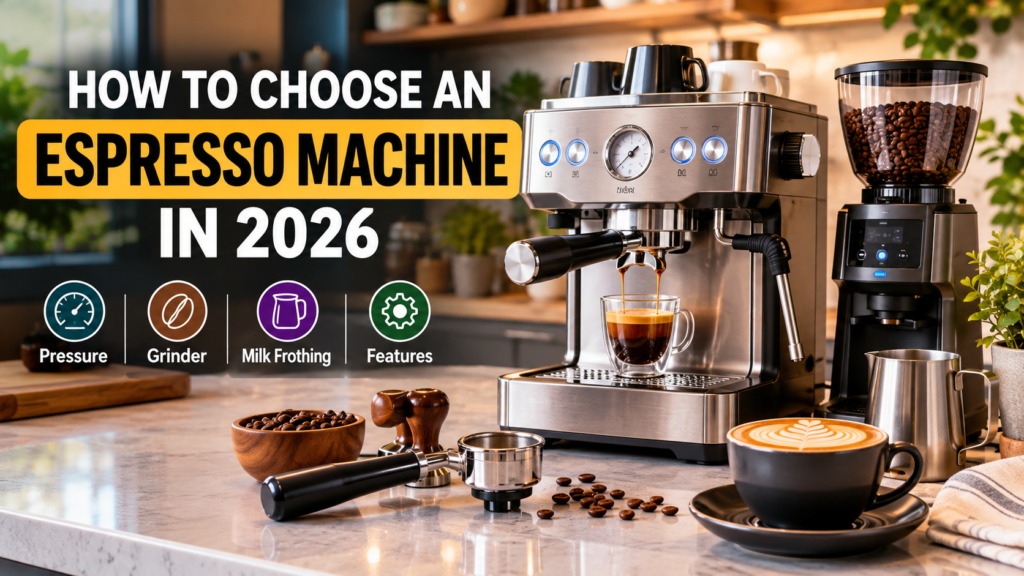
Learn how to choose an espresso machine in 2026. Compare pressure, grinders, milk frothing, heating systems, features, budgets, and common buying mistakes.
KitchenLabZone is a reader-supported website. This means that when you click on certain links on our site and make a purchase, we may earn a small commission—at no additional cost to you.
As an Amazon Associate, KitchenLabZone earns from qualifying purchases. These affiliate links help us keep our content free, up-to-date, and helpful for our readers.We only recommend products that we genuinely believe offer value and are relevant to our audience. Our reviews and recommendations are based on research, user feedback, and personal opinions, not influenced by affiliate partnerships.Your support through these links allows us to continue providing high-quality kitchen guides, product reviews, and buying advice.
If you have any questions regarding this disclosure, feel free to contact us.
Thank you for supporting KitchenLabZone!
Shopping for an espresso machine in 2026 means wading through spec sheets that all claim to be the most powerful, the most professional, or the most automatic option on the shelf. Pump pressure numbers get bigger every year. Touchscreens get flashier. And yet the coffee two people make with two very different machines can taste almost identical — while two people with the “same” 15-bar machine can pull completely different shots depending on their grinder and technique.
This guide skips the marketing language and walks through what actually determines espresso quality: pressure regulation, grind consistency, heating stability, and how you plan to steam milk. By the end, you’ll be able to read a spec sheet the way a home barista does, not the way an ad copywriter wants you to.
Quick Overview
If you only have two minutes, here’s what actually matters:
- Pressure: A 15-bar or 20-bar pump rating is a maximum output number, not the pressure hitting your coffee. Extraction happens closer to 9 bar regardless of what the pump can theoretically produce.
- Grinder: A quality burr grinder affects flavor more than almost any other single purchase. A mediocre machine with a great grinder usually beats a great machine with pre-ground coffee.
- Heating: Thermoblocks heat fast and suit occasional espresso drinkers; heat exchangers and dual boilers suit people who steam milk daily and want stable temperatures shot after shot.
- Milk: Manual steam wands give the most control (and the steepest learning curve); automatic wands and carafes trade some texture control for convenience.
- Budget: Treat “machine + grinder + accessories” as one combined number, not a machine-only purchase.
| What Matters | What to Look For | Why It Matters |
|---|---|---|
| Pressure | Properly regulated extraction pressure, not a big pump number | Consistent, balanced shots |
| Grinder | Burr grinder with fine, repeatable adjustment | Even extraction, no bitterness or sourness |
| Heating system | Stable brew temperature under real use | Repeatable results, shot after shot |
| Milk system | Steam power and control that match your drinks | Better texture in lattes and cappuccinos |
| Machine type | Matches your skill level and patience | Less frustration, faster daily workflow |
| Counter space | Fits your kitchen without crowding | Everyday usability |
| Cleaning | Manageable maintenance routine | Machine lasts longer, tastes better longer |
| Total budget | Machine, grinder, and accessories combined | A realistic, satisfying first setup |
Start With These 7 Questions Before You Buy
Before comparing individual machines, answer these questions honestly. Your answers will point you toward a machine category — which matters more than any single model.
1. What drinks do you make most often? Straight espresso and americanos need less from a machine than daily lattes and cappuccinos. If milk drinks dominate your routine, steam performance should carry real weight in your decision.
2. Do you already own an espresso-capable grinder? If yes, you can consider machines without a built-in grinder and put more of your budget into the machine itself. If no, factor a separate burr grinder into your total cost from the start.
3. How much control do you want? Some buyers want to dial in grind size, dose, and shot time like a hobby. Others want to press one button and walk away. Neither is wrong — but they point to very different machine types.
4. How many drinks will you make per day? One or two drinks a day is a different use case than a household making six or eight. Higher daily volume favors machines with better heat recovery and larger water tanks.
5. Do you need powerful milk steaming? Occasional milk drinks are fine with a basic steam wand. Daily lattes for a whole household benefit from stronger, faster steam power.
6. How much counter space do you have? Compact apartments and small kitchens benefit from smaller footprints. If space is tight, our guide to best coffee makers for small kitchens in 2026 covers footprint-friendly options across coffee maker types, not just espresso.
7. What is your realistic total setup budget? Decide on a number that includes the machine, a grinder if you need one, and basic accessories — not just the machine’s sticker price.
Espresso Machine Types Explained
There is no single “best” type of espresso machine — only the type that fits how you actually want to make coffee. Here’s how the main categories compare.

- BE YOUR OWN BARISTA: Café-quality espresso shouldn’t require a PhD. The Ninja Luxe Cafe Premier is a 3-in-1 machine desi…
- 3 MACHINES IN 1: Includes 2 Espresso Styles — double shot or quad shot, 3 Drip Coffee Styles—classic, rich or over ice, …
- HANDS-FREE FROTHING: Dual Froth System combines a spinning whisk with automatic steamer to produce perfect, silky-smooth…
| Type | How It Works | Control Level | Ease of Use | Grinder Needed | Milk Convenience | Cleaning | Typical Buyer | Main Advantage | Main Drawback |
|---|---|---|---|---|---|---|---|---|---|
| Manual/lever | You manually control water flow via a lever or piston | Very high | Low | Yes (separate) | Manual steam wand only | Moderate | Hobbyists who enjoy the ritual | Full control over every variable | Steep learning curve |
| Semi-automatic | You start/stop the shot; pump controls pressure | High | Moderate | Yes (separate, usually) | Manual steam wand | Moderate | Home baristas who want to learn | Best balance of control and accessibility | Requires practice to dial in |
| Automatic | Machine controls shot volume automatically | Medium | High | Sometimes built in | Manual or automatic wand | Moderate | Buyers who want consistency without full manual control | Repeatable shots with less guesswork | Less flexibility for adjusting on the fly |
| Super-automatic | Grinds, doses, tamps, and brews at the push of a button | Low | Very high | Built in | Often one-touch milk drinks | Higher (internal components) | Convenience-first buyers, offices, upgrading from pods | Minimal effort, consistent daily use | Less control over espresso quality, pricier to maintain |
| Pod/capsule | Pre-portioned pods brew a single drink | Very low | Very high | Not applicable | Often built in for milk pods | Very low | Beginners, small households, simplicity seekers | Fastest, simplest, least mess | Less flavor control, ongoing pod cost, less “real espresso” character |
If you’re comparing espresso machines against broader daily-use options, our roundup of best coffee makers for daily use in 2026 is a useful companion for households that drink both espresso-based and regular coffee.
How Much Pressure Does an Espresso Machine Need?
This is where the most marketing confusion happens, so let’s be precise.
What bar pressure actually means. “Bar” is a unit of pressure. Espresso brewing pushes hot water through tightly packed, finely ground coffee, and that resistance requires meaningful pressure to extract properly.
Why machines advertise 15, 19, or 20 bar. These numbers describe the maximum output the pump is capable of, not the pressure that actually reaches your coffee puck during extraction. A pump rated for 20 bar isn’t brewing at 20 bar — that would produce harsh, over-extracted, often undrinkable espresso.
Why extraction pressure is different. Espresso extraction is widely referenced around roughly 9 bar at the puck. This figure traces back to early Italian espresso machines and has since been echoed in industry brewing references. The Specialty Coffee Association’s historical espresso definition describes water forced through the grounds at roughly 9–10 atmospheres of pressure, ground fine enough to produce a 20–30 second brew time. That range — not the number printed on the box — is the actual target.
The role of the OPV. An Over Pressure Valve (OPV) regulates how much of the pump’s output actually reaches the group head, diverting excess water so the puck receives a controlled, steady pressure rather than the pump’s full maximum. In plain terms: the OPV is what keeps a 15-bar-rated pump from blasting your coffee at 15 bar. It’s the reason two machines with very different advertised pump numbers can produce nearly identical extraction pressure.
Pre-infusion. Many semi-automatic and higher-end machines briefly wet the coffee puck at low pressure before ramping up to full extraction pressure. This helps the grounds swell evenly and reduces “channeling,” where water rushes through weak spots in the puck instead of extracting evenly.
Why stability matters more than a big number. A machine that holds a steady, properly regulated pressure through the entire shot will consistently outperform one that merely has a higher pump ceiling. Consistency, not maximum output, is what separates a balanced shot from a harsh or watery one.
| Marketing Claim | What It Actually Tells You | What Buyers Should Check |
|---|---|---|
| “15 bar pump” | Maximum pump output capability | Whether the machine has proper pressure regulation (OPV), not just a high number |
| “20 bar pump” | Even higher maximum output — not brewing pressure | Same as above; a bigger number alone says nothing about shot quality |
| “Professional-grade pressure” | Vague marketing language | Look for actual specifications: pre-infusion, PID, pressure gauge |
| “9-bar extraction” | A commonly referenced target extraction pressure | Whether the machine is designed to regulate down to a consistent range near this figure |
Why the Grinder Matters So Much
If you take one thing away from this guide, make it this: the grinder shapes your espresso more than most people expect — often as much as the machine itself.
Grind consistency is the foundation of good extraction. Espresso is uniquely sensitive to grind size because water is forced through the grounds quickly and under real pressure. If particle sizes vary too much, water finds the path of least resistance through larger particles while over-extracting the fine dust around them, producing a shot that’s simultaneously bitter and sour.
Burr grinders vs. blade grinders. A burr grinder crushes beans between two textured surfaces set at a controlled, adjustable gap, producing consistently sized particles. A blade grinder chops beans with a spinning blade and has no real way to control particle size — some pieces end up as fine dust, others as coarse chunks. For drip coffee this inconsistency is forgivable; for espresso, it produces genuinely uneven, poor-tasting shots. If you’re serious about espresso, a burr grinder isn’t a luxury upgrade — it’s close to a requirement.
Conical vs. flat burrs, at a high level. Flat burrs tend to produce a very uniform particle distribution, which some tasters associate with clarity in the cup. Conical burrs tend to run quieter and cooler. Both geometries can produce excellent espresso; burr size and build quality generally matter more than which shape you choose.
Built-in vs. standalone grinders.
- Built-in grinder pros: one footprint, one machine to learn, often more affordable as a bundle, convenient for beginners.
- Built-in grinder cons: usually less precise adjustment than a dedicated grinder, and if the grinder fails, the whole machine may need service.
- Standalone grinder pros: typically finer, more repeatable adjustment; can be upgraded independently of the machine.
- Standalone grinder cons: adds counter space, adds cost, adds one more device to clean and maintain.
Stepless vs. stepped adjustment. Stepped grinders move between fixed settings; stepless grinders allow micro-adjustments anywhere along the range. Espresso often benefits from finer control than drip coffee does, since even small grind changes noticeably affect shot time and flavor — so stepless adjustment is worth prioritizing if your budget allows it.
Why pre-ground coffee limits espresso quality. Pre-ground coffee is usually cut to a generic grind size, begins losing aromatic compounds soon after grinding, and can’t be adjusted to your specific machine, altitude, or bean. Freshly ground coffee, ground to order, is one of the simplest upgrades available to any home setup.
A realistic budget approach. Instead of spending your entire budget on the espresso machine and treating the grinder as an afterthought, many home baristas find better results allocating a meaningful share of the total budget to a quality burr grinder — sometimes close to what they spend on the machine itself. A modest machine paired with a good grinder often outperforms an expensive machine paired with pre-ground coffee or a low-quality grinder.
- BE YOUR OWN BARISTA: Café-quality espresso shouldn’t require a PhD. The Ninja Luxe Cafe Premier is a 3-in-1 machine desi…
- 3 MACHINES IN 1: Includes 2 Espresso Styles — double shot or quad shot, 3 Drip Coffee Styles—classic, rich or over ice, …
- HANDS-FREE FROTHING: Dual Froth System combines a spinning whisk with automatic steamer to produce perfect, silky-smooth…
How to Choose the Right Milk-Frothing System
Milk texture is often what separates a homemade latte from a café-quality one, and different systems suit different drinkers.
| System | How It Works | Best Suited For |
|---|---|---|
| Manual steam wand | You control angle, depth, and timing by hand | Latte-art enthusiasts, people who want full texture control |
| Automatic steam wand | Wand automates part of the process (temperature or texture presets) | Buyers who want good milk with less manual skill |
| Automatic milk carafe | Machine draws milk from an attached container and dispenses it | One-touch convenience, daily lattes/cappuccinos with minimal effort |
| Separate electric milk frother | Standalone device froths milk independent of the espresso machine | Buyers using a machine without steam capability, or wanting a simpler cleanup |
What microfoam actually is. Good milk texture — the silky, glossy “microfoam” used for lattes and cappuccinos — comes from introducing air into cold milk early in the steaming process, then folding it into a smooth, fine-bubbled texture as the milk heats. Large, coarse bubbles indicate poor technique or a weak steam wand, not necessarily bad milk.
Matching systems to drinkers:
- Latte drinkers generally want smooth, well-integrated microfoam — manual or automatic wands both work, though manual wands offer more control over the final texture.
- Cappuccino drinkers want more foam volume, which most steam wand types handle comfortably.
- Flat-white drinkers want dense, minimal foam — manual control tends to make this easier to fine-tune.
- Beginners often do better starting with an automatic wand or carafe system to build confidence before learning manual technique.
- Latte-art enthusiasts should prioritize a manual wand with real steam power and practice pouring technique separately from the machine itself.
- Convenience-first buyers are usually better served by an automatic carafe or one-touch system, even if it means slightly less textural control.
Steam power and temperature control. Stronger steam output generally means faster milk heating and more consistent texture, especially for back-to-back drinks. Some higher-end machines allow separate steam temperature adjustment, which can help with plant-based milks that scorch more easily than dairy.
Cleaning milk systems. Steam wands need to be purged and wiped after every use to prevent dried milk buildup. Automatic carafes and milk systems typically need scheduled internal rinse or cleaning cycles — convenient day-to-day, but worth checking how involved the deep-clean process is before buying.
Dairy and plant-based milk. Different milks foam differently — some plant-based options froth well, others need higher-protein “barista” formulations to texture properly. No single milk type is universally superior; it comes down to personal taste and how a particular milk responds to your machine’s steam power.
If you’d rather separate milk frothing from your espresso machine entirely, our guides to best milk frothers for coffee lovers and best electric and handheld milk frothers cover standalone options worth considering.
Thermoblock vs Single Boiler vs Heat Exchanger vs Dual Boiler
Heating systems affect two practical things: how long you wait before your first shot, and how consistent temperature stays if you’re steaming milk and brewing back-to-back.
Thermoblock / ThermoJet. Water passes through a heated metal block (or a coiled variant) and heats almost instantly on demand. This means fast warm-up times and a compact footprint, which is why thermoblocks are common in entry-level and super-automatic machines. Modern versions have improved significantly, though they can still show more temperature fluctuation than boiler-based systems, especially when steaming and brewing in quick succession.
Single boiler. One boiler heats water for both brewing and steaming, usually requiring a brief wait to switch between the two temperatures. Fine for people who brew and steam sequentially rather than at the same time, and typically more affordable than dual-purpose systems.
Heat exchanger. A single larger boiler stays near steam temperature, with a heat-exchange coil flash-heating fresh water to brewing temperature as it passes through. This allows brewing and steaming at the same time, at a lower cost than a full dual-boiler system — a genuinely popular middle-ground design in prosumer machines.
Dual boiler. Two fully independent boilers — one dedicated to brewing, one to steaming — hold their own temperatures simultaneously. This produces the most consistent temperature stability of the four systems, particularly under heavier daily use, but comes with a higher price, larger footprint, and more components that can eventually need service.
- BE YOUR OWN BARISTA: Café-quality espresso shouldn’t require a PhD. The Ninja Luxe Cafe Premier is a 3-in-1 machine desi…
- 3 MACHINES IN 1: Includes 2 Espresso Styles — double shot or quad shot, 3 Drip Coffee Styles—classic, rich or over ice, …
- HANDS-FREE FROTHING: Dual Froth System combines a spinning whisk with automatic steamer to produce perfect, silky-smooth…
| Heating System | Best For | Advantages | Limitations |
|---|---|---|---|
| Thermoblock / ThermoJet | Occasional espresso drinkers, compact kitchens | Fast heat-up, compact size, lower cost | More temperature variance under heavy back-to-back use |
| Single boiler | Buyers who brew and steam one at a time | Simple, affordable, smaller footprint | Wait time when switching between brew and steam modes |
| Heat exchanger | Buyers who want simultaneous brew/steam without dual-boiler pricing | Brew and steam together, strong value for the capability | Can show minor temperature drift during heavy steam use |
| Dual boiler | Daily milk-drink households, buyers who want maximum consistency | Most stable temperatures, brew and steam fully independent | Higher price, larger footprint, more maintenance points |
Why Temperature Stability Matters
Espresso extraction is sensitive to temperature the same way it’s sensitive to pressure and grind size. Water that’s too cool under-extracts and tastes sour or flat; water that’s too hot over-extracts and tastes bitter or burnt. What matters day to day isn’t just hitting the “right” temperature once, but holding it steady across an entire shot — and across multiple shots if you’re making drinks for more than one person.
PID temperature control is an electronic control system that continuously monitors and fine-tunes heating element output, rather than simply switching the heater on and off around a rough target like a basic thermostat. The practical result is a narrower, more repeatable temperature band shot after shot. PID control isn’t essential for casual espresso drinking, but it becomes genuinely valuable for anyone chasing consistency or experimenting with different roasts and origins, where a few degrees can noticeably change flavor.
Portafilters and Baskets Explained
Portafilter size. Portafilters vary by diameter across brands and machine tiers; a larger portafilter generally holds a larger basket, which allows for bigger doses and more flexibility with double shots.
Pressurized baskets. These have a restrictive valve that helps build crema even with inconsistent grind size or stale pre-ground coffee. They’re forgiving for beginners but tend to mask, rather than reflect, your actual grind and dose choices.
Non-pressurized baskets. These rely entirely on your grind size, dose, and tamp to build proper resistance and pressure. They give a more honest, adjustable result once you have a decent burr grinder, but are less forgiving of mistakes.
Single vs. double baskets. A single basket is sized for one shot’s worth of grounds; a double is sized for two. Many home baristas use the double basket almost exclusively, since it gives more room to dial in dose and produces a more balanced extraction.
Why this matters for different buyers. Beginners using pre-ground coffee or still learning grind adjustment often get more forgiving results from a pressurized basket. Buyers investing in a proper burr grinder should generally move to a non-pressurized basket to get results that actually reflect their grind and dosing choices.
- BE YOUR OWN BARISTA: Café-quality espresso shouldn’t require a PhD. The Ninja Luxe Cafe Premier is a 3-in-1 machine desi…
- 3 MACHINES IN 1: Includes 2 Espresso Styles — double shot or quad shot, 3 Drip Coffee Styles—classic, rich or over ice, …
- HANDS-FREE FROTHING: Dual Froth System combines a spinning whisk with automatic steamer to produce perfect, silky-smooth…
Features That Actually Matter
| Feature | Rating | Why |
|---|---|---|
| Pre-infusion | Useful | Reduces channeling, improves extraction evenness |
| Shot timer | Useful | Helps you replicate good shots and diagnose bad ones |
| Volumetric dosing | Nice to have | Convenient for consistent shot volume, less critical for manual control fans |
| Adjustable brew temperature | Useful | Helps fine-tune different roast levels |
| Pressure gauge | Useful | Lets you visually confirm extraction pressure and spot problems |
| Water reservoir size | Essential (for household use) | Fewer refills during busy mornings |
| Hot-water outlet | Nice to have | Convenient for americanos and tea, not core to espresso quality |
| Steam wand quality | Essential (for milk drinkers) | Directly affects milk texture and steaming speed |
| Cup clearance | Useful | Determines whether you can fit taller mugs or travel cups underneath |
| Removable water tank | Essential | Makes refilling and cleaning dramatically easier |
| Cleaning/descale indicators | Useful | Helps maintain consistent taste and machine lifespan |
| Descaling programs | Useful | Simplifies a maintenance task that’s easy to neglect |
| Water filtration | Useful | Protects internal components and can improve taste, especially with hard water |
| Programmable settings | Nice to have | Convenient for repeat drinks, not essential for casual use |
| Automatic shutoff | Nice to have | Small safety/energy convenience |
| Countertop footprint | Essential | Determines whether the machine actually fits your kitchen |
- BE YOUR OWN BARISTA: Café-quality espresso shouldn’t require a PhD. The Ninja Luxe Cafe Premier is a 3-in-1 machine desi…
- 3 MACHINES IN 1: Includes 2 Espresso Styles — double shot or quad shot, 3 Drip Coffee Styles—classic, rich or over ice, …
- HANDS-FREE FROTHING: Dual Froth System combines a spinning whisk with automatic steamer to produce perfect, silky-smooth…
Features You Shouldn’t Overpay For
Some features sound impressive on a box but add little to actual espresso quality:
- 20-bar pump marketing. As covered above, a higher maximum pump rating alone tells you almost nothing about extraction quality.
- “Professional” wording without specifications. If a listing uses the word “professional” but doesn’t mention pressure regulation, PID, or a real boiler type, treat it as marketing language, not a spec.
- Huge drink-count claims on super-automatics. “16 pre-programmed drinks” sounds impressive, but most buyers regularly use only two or three of them.
- Touchscreens that don’t improve workflow. A touchscreen can be nice, but it doesn’t make espresso taste better — it’s a convenience feature, not a quality feature.
- Decorative stainless-steel finishes. Attractive, but purely aesthetic; it doesn’t affect what’s happening in the portafilter.
- Excessive preset drinks. More presets can mean more complexity to navigate for the two or three drinks you’ll actually make regularly.
- Features that add cleaning complexity without real benefit. Extra internal milk lines or automated systems can mean more parts to disassemble and clean, without a proportional improvement in taste.
The key distinction to keep in mind throughout: a feature can be genuinely convenient without meaningfully improving your espresso.
How Much Should You Spend on an Espresso Setup in 2026?
Rather than fixed prices (which shift constantly), think in tiers:
Entry-level. Simpler machines, often thermoblock-based, sometimes bundled with a basic grinder. A practical choice for beginners upgrading from pod machines who want to learn fundamentals without a large upfront commitment.
Mid-range. Better pressure regulation, sometimes pre-infusion, often a meaningfully improved steam wand. This tier is where many home baristas find their long-term “daily driver” machine.
Premium. Heat exchangers or early dual-boiler options, PID control, sturdier build quality, and often a separate high-quality grinder recommended alongside it.
Prosumer. Near-commercial components — dual boilers, saturated groups, precise pressure profiling — built for buyers who want café-level consistency and are willing to invest accordingly.
The most important budget principle: machine + grinder + accessories = total setup cost. A buyer who spends their entire budget on the machine and grabs the cheapest available grinder (or none at all) often ends up disappointed with the results, despite owning an objectively capable machine.
Typical accessories worth budgeting for:
- Burr grinder (if not built in)
- A small kitchen scale for dosing
- A tamper sized to your portafilter
- A knock box for used grounds
- A milk pitcher, if you’ll be steaming manually
- Basic cleaning supplies (brush, cleaning tablets)
- A water filter, especially in hard-water areas
You don’t need every accessory on day one — a scale and a decent tamper make the biggest early difference, and the rest can be added as your routine develops.
Espresso Machine Buying Decision Tree
Use these scenarios to identify a suitable machine category — not a single “correct” model:
- I am a complete beginner → An automatic or entry-level semi-automatic machine, ideally with a separate but affordable burr grinder, keeps the learning curve manageable.
- I mainly drink straight espresso → Prioritize pressure regulation, grind quality, and temperature stability over milk-system features.
- I make lattes every day → Weigh steam power and milk convenience heavily; consider a heat exchanger or dual boiler if budget allows.
- I want the easiest possible setup → A super-automatic or a well-reviewed pod/capsule machine minimizes daily effort.
- I want maximum control → A semi-automatic or manual/lever machine paired with a precise standalone grinder.
- I have a small kitchen → Prioritize compact footprint; see our guide to best coffee makers for small kitchens in 2026 for footprint comparisons.
- I already own a good grinder → Put more of your budget into the machine itself, particularly pressure regulation and steam performance.
- I want an integrated grinder → Look at automatic or super-automatic machines with built-in grinders, and check user feedback on grind consistency specifically.
- I make several milk drinks every day → A heat exchanger or dual-boiler machine avoids temperature drift during back-to-back steaming.
- I want a machine I can grow into → A semi-automatic with pre-infusion and a pressure gauge gives room to develop skill over time.
- I hate complicated cleaning → Favor machines with removable components, simple descale programs, and fewer internal milk pathways.
Common Espresso Machine Buying Mistakes
- Buying based on bar pressure alone. A high pump number says nothing about extraction quality without proper regulation.
- Ignoring the grinder. The single most common reason home espresso disappoints buyers who spent well on the machine.
- Spending the entire budget on the machine. Leaves nothing for a decent grinder or basic accessories.
- Choosing a machine that’s too complicated for your patience level. A manual machine bought for its “pro” reputation often ends up abandoned if you wanted convenience.
- Ignoring milk-drink needs. Buyers who drink lattes daily but bought a machine with a weak steam wand often regret it quickly.
- Ignoring counter dimensions. Measure your space, including clearance for opening the water tank and portafilter.
- Ignoring water quality. Hard water accelerates scale buildup and can affect both taste and machine lifespan.
- Forgetting cleaning requirements. A machine that’s a hassle to clean often gets cleaned less often — which shortens its life and hurts flavor.
- Buying a machine without considering basket type. Pressurized vs. non-pressurized baskets change how forgiving (or demanding) your workflow will be.
- Assuming expensive automatically means better. A premium machine paired with the wrong grinder, or the wrong feature set for your habits, can underperform a smarter, cheaper setup.
- Ignoring warranty and service availability. Espresso machines have moving mechanical parts; check how repairs and parts are handled before buying.
- Buying features you’ll never use. Extra presets, touchscreens, or drink customization options add cost without adding value if you’ll only ever make two drinks.
How to Check the Machine Before You Buy
Before finalizing a purchase, look for:
- Clear specification of both pump rating and a regulated extraction pressure or OPV mention
- Confirmation of the heating system type (thermoblock, single boiler, heat exchanger, or dual boiler)
- Steam wand type and whether it’s manual or automatic
- Basket type included (pressurized vs. non-pressurized), and whether both are available
- Water tank capacity relative to your household’s daily drink count
- Available warranty length and where repairs are handled
- Real buyer reviews mentioning long-term reliability, not just first-week impressions
Espresso Machine Maintenance: What You Need to Know
Every espresso machine needs some routine care, regardless of price tier:
- Daily: Purge and wipe the steam wand after each use; empty and rinse the drip tray.
- Weekly: Backflush (if your machine supports it) and clean the portafilter and basket thoroughly.
- Every 1–3 months (or per manufacturer guidance): Descale, especially if you don’t use filtered water. Mineral buildup affects both taste and heating efficiency over time.
- Ongoing: Use filtered or appropriately treated water where possible — water quality is one of the most overlooked factors in both machine longevity and cup flavor.
Final Buying Checklist
☐ I know which drinks I make most often ☐ I know whether I need a grinder ☐ I understand pressure specifications ☐ I checked the heating system ☐ I evaluated milk frothing needs ☐ I measured my counter space ☐ I checked water-tank capacity ☐ I understand cleaning requirements ☐ I considered warranty and service availability ☐ I calculated my total setup cost (machine + grinder + accessories) ☐ I am not buying based on marketing numbers alone
Frequently Asked Questions
How do I choose an espresso machine for home? Start with your drink habits, not the spec sheet. Decide how much milk frothing you need, how much control you want, how much counter space you have, and your total budget including a grinder — then match those answers to a machine category.
Is 15 bar or 20 bar better for espresso? Neither number, by itself, tells you much. Both are maximum pump ratings, not extraction pressure. What matters is whether the machine properly regulates that pressure down to a consistent extraction range.
Is 9 bar really the ideal espresso pressure? It’s the most commonly referenced figure for extraction pressure at the puck, echoed in longstanding industry definitions of espresso. It’s a useful benchmark rather than an absolute rule — some machines and styles (like certain lever machines) intentionally brew at lower pressures.
Do I need a grinder with an espresso machine? Yes, in practice. Pre-ground coffee limits flavor and consistency significantly. Either buy a machine with a quality built-in grinder or budget for a separate burr grinder.
Is a built-in grinder worth it? It’s convenient and saves counter space, but usually offers less precise adjustment than a good standalone grinder. It’s a solid choice for beginners; enthusiasts often prefer a separate grinder eventually.
What type of espresso machine is best for beginners? Automatic or straightforward semi-automatic machines tend to offer the easiest learning curve while still producing genuine espresso, especially when paired with a decent grinder.
What is the difference between semi-automatic and super-automatic espresso machines? Semi-automatic machines require you to grind, dose, tamp, and start/stop the shot manually. Super-automatic machines handle grinding, dosing, and brewing automatically at the push of a button.
Is PID temperature control worth it? It’s not essential for casual use, but it meaningfully improves shot-to-shot consistency, which matters more as you get pickier about flavor or experiment with different beans.
What is better for milk drinks: a steam wand or automatic frother? Neither is universally better. Manual wands give more control and are preferred for latte art; automatic systems trade some control for convenience and speed.
Is a dual-boiler espresso machine worth the extra money? For households making multiple milk drinks daily, the temperature stability can be worth it. For occasional or single-user setups, a heat exchanger or even a good thermoblock machine may be more cost-effective.
How much should I spend on my first espresso machine? There’s no universal number — but plan your total budget around the machine, grinder, and basic accessories together rather than spending it all on the machine alone.
What features matter most in an espresso machine? Pressure regulation, grind quality (whether built-in or separate), steam performance suited to your milk habits, and manageable cleaning requirements matter more than flashy extras.
How often should an espresso machine be cleaned? Daily wiping and purging of the steam wand, weekly deeper cleaning of the portafilter and basket, and periodic descaling based on your water hardness and usage frequency.
Does water quality affect espresso machines? Yes. Hard water accelerates scale buildup, which can affect heating efficiency, machine lifespan, and taste. Filtered water is a simple, low-cost improvement for most home setups.
What accessories do I actually need? At minimum, a decent tamper and a small scale. A knock box, milk pitcher, and cleaning supplies are worth adding as your routine develops.
Conclusion
The best espresso machine for you isn’t the one with the biggest pump number or the longest feature list — it’s the one that matches your drinks, your patience for hands-on control, your kitchen space, and a budget that includes a real grinder. Read past the marketing language, check for genuine pressure regulation and a heating system suited to how often you steam milk, and treat your grinder as part of the purchase, not an afterthought. Get those fundamentals right, and almost any machine in the right category will make noticeably better coffee than the pod machine it’s replacing.
Suggested Internal Links Used
- best coffee makers for small kitchens in 2026 — used twice, in the “7 Questions” section (counter space) and in the Decision Tree (“I have a small kitchen” scenario)
- best coffee makers for daily use in 2026 — used in the Machine Types section, comparing espresso machines to broader daily coffee options
- best milk frothers for coffee lovers — used in the Milk-Frothing section
- best electric and handheld milk frothers — used in the Milk-Frothing section
Suggested External Sources Used
- Specialty Coffee Association — “Defining the Ever-Changing Espresso” (heritage espresso definition, including the 9–10 atmosphere pressure reference): https://sca.coffee/sca-news/25-magazine/issue-3/defining-ever-changing-espresso-25-magazine-issue-3
- Specialty Coffee Association — SCA Water Standards / water quality guidelines reference page: https://www.sca.coffee/heritage-coffee-standards
- Clive Coffee — burr vs. blade grinder education for espresso: https://clivecoffee.com/blogs/learn/blade-grinder-vs-burr-grinder-for-espresso-clive-coffee
- Seattle Coffee Gear — heat exchanger vs. dual boiler explainer: https://www.seattlecoffeegear.com/blogs/scg-blog/heat-exchangers-vs-dual-boilers
- La Marzocco USA — brewing pressure and OPV education: https://home.lamarzoccousa.com/brewing-espresso-at-6-bar/
(All URLs should be spot-checked again at publish time in case of link changes.)
Featured Image / Thumbnail Concept
Format: 16:9, premium U.S. kitchen aesthetic
Scene: A modern semi-automatic espresso machine sits on a clean quartz or butcher-block countertop, portafilter attached and visibly loaded with a fresh puck of espresso. A compact standalone burr grinder sits just beside it with a small pile of whole beans nearby. A stainless steel milk pitcher with a light dusting of latte foam sits to one side, next to a finished latte in a ceramic cup. Soft, warm natural light (as if from a nearby window) gives the scene a bright, inviting, editorial coffee-shop-at-home feel. Background is softly blurred — a hint of open shelving or a subway-tile backsplash, nothing cluttered or busy. No visible text, logos, or brand names in the image itself.
Thumbnail Text Options
- “Espresso Machines, Decoded: What Actually Matters in 2026”
- “Stop Buying by Bar Pressure Alone — Here’s What to Check”
- “The 2026 Espresso Machine Guide: Pressure, Grinder & Milk, Explained”
Suggested Image Alt Text
“Modern espresso machine with portafilter, burr grinder, and milk pitcher on a kitchen countertop, representing a complete home espresso setup”